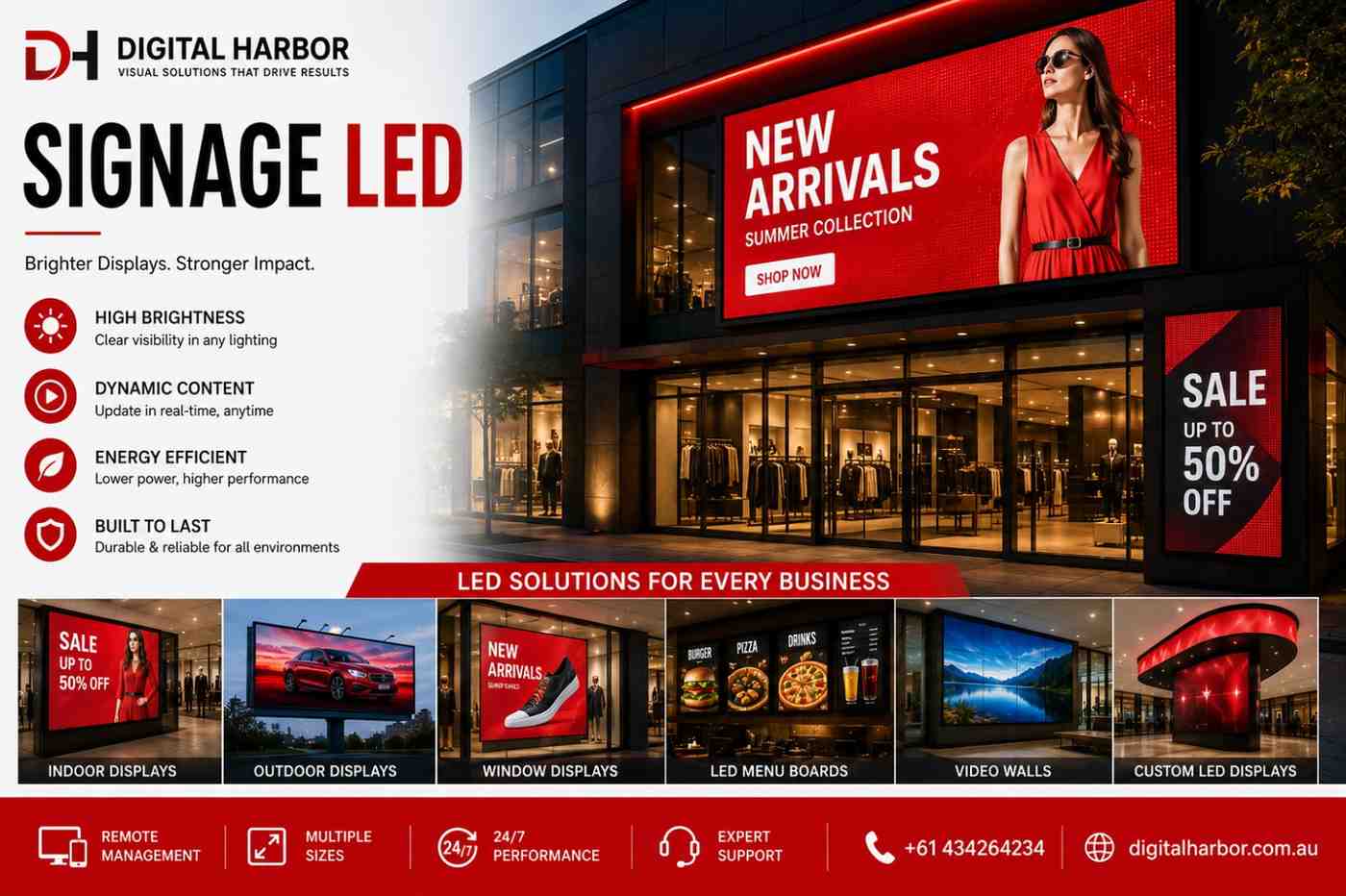
If your business is still relying on printed banners or backlit static boards, you are already a step behind. Signage LED has quietly become the standard for businesses that want to be noticed, remembered, and taken seriously.
But what exactly is it, and why does it matter for you? This guide walks you through everything in plain language, no jargon, no unnecessary complexity.
LED stands for Light Emitting Diode. In the context of business signage, signage LED refers to display systems that use LED technology to produce bright, vivid, energy-efficient visuals. These range from slim indoor panels to massive outdoor screens that stay visible even in full sunlight.
The difference between traditional signage and LED signage is a bit like the difference between a candle and a floodlight. Both produce light. Only one commands attention.
Why LED Signage Has Become the Go-To for Modern Businesses
There is a reason virtually every major retailer, restaurant chain, and corporate brand has moved toward LED signage. It is not just about aesthetics. It is about performance.
A report by the Digital Signage Federation found that businesses using dynamic LED displays see up to a 33% increase in sales for promoted items compared to static signage. That is not a small margin. For a cafe promoting its lunch special or a retailer highlighting a new arrival, that kind of lift is genuinely significant.
In my experience, the most common thing business owners say after switching to LED signage is that they wished they had done it sooner. The response from customers is almost immediate. Foot traffic improves. People stop. People look. People come in.
And from an operational perspective, the ability to update your signage remotely from a phone or laptop without calling a printer, a designer, or an installation crew every single time is a freedom that is hard to overstate.
Understanding the Different Types of Signage LED
Not every LED display is designed for the same job. Choosing the right type for your space and your goals is one of the most important decisions you will make. Here is a breakdown of the main formats you will encounter.
Indoor LED Signage
Designed for controlled environments like retail stores, restaurants, office lobbies, and shopping centres. Indoor LED panels typically operate at lower brightness levels because they do not need to compete with sunlight, which also means they use less energy and run quietly.
When I tried an indoor LED menu board installation at a small restaurant client's space, the owner told me within the first week that customers were spending more time reading the menu, asking about specials they had not noticed before, and overall spending slightly more per visit. Small change. Real result.
Outdoor LED Signage
This is where LED technology really earns its reputation. Outdoor signage LED panels are built to withstand rain, heat, dust, and UV exposure while maintaining brilliant visibility even at midday. Brightness levels for outdoor use typically start at 2500 nits and go significantly higher for direct sunlight applications.
If you run a business with street frontage, an outdoor LED display is one of the highest-visibility marketing tools available to you. It works around the clock without any additional effort on your part.
Window LED Displays
A smart hybrid between indoor and outdoor signage. These ultra-bright screens are placed directly against shop windows, turning your glass frontage into a live advertising surface. Passersby see your promotions without ever stepping inside.
I have noticed that businesses in high-footfall areas, particularly on busy high streets and in shopping centres, generate a measurable increase in walk-in enquiries within weeks of installing a quality window LED display.
Video Wall LED Displays
Multiple LED panels tiled together to form one large, seamless display surface. Video walls are used in corporate reception areas, entertainment venues, airports, and large retail flagships where sheer visual scale is the goal. A well-executed LED video wall does not just show content. It creates an environment.
Custom LED Displays
Sometimes your space does not fit a standard screen size. Custom signage LED solutions allow you to specify exact dimensions, shapes, and configurations. Whether it is a curved installation, a non-standard aspect ratio, or a multi-panel layout designed around your architecture, custom LED panels bridge the gap between what is available off-the-shelf and what your space actually needs.
Key Features to Look for in a Signage LED System
Before committing to any LED signage solution, there are several features worth understanding. These are the things that separate a display that performs well for years from one that causes problems within months.
Pixel Pitch
Pixel pitch refers to the distance between individual LED clusters on a panel, measured in millimetres. A smaller pixel pitch means higher resolution and sharper image quality up close. For displays viewed from a distance, a larger pixel pitch is acceptable and often more cost-effective. Matching pixel pitch to your viewing distance is important.
Brightness and Contrast
Brightness is measured in nits. The higher the nit rating, the more visible the display is in brighter environments. For indoor use, 800 to 1500 nits is typically sufficient. For window-facing or outdoor applications, look for 2500 nits or higher. Contrast ratio affects how vivid colours appear, particularly in mixed lighting conditions.
Refresh Rate
A higher refresh rate means smoother motion and eliminates the flicker effect that can appear when screens are captured on camera. For businesses in media-heavy environments or those who photograph or film their space regularly, this matters more than it might seem.
Content Management Software
The software behind your signage LED system is just as important as the hardware in front of it. Look for platforms that offer remote management, scheduling, multi-screen control, and real-time updates. The best systems let you control everything from a single dashboard on your phone.
Build Quality and IP Rating
For any outdoor or semi-outdoor installation, check the IP (Ingress Protection) rating. This tells you how well the unit handles moisture and dust. An IP65 rating, for example, means the unit is fully dust-tight and protected against water jets from any direction. Never install a panel without confirming its IP rating for the intended environment.
Where Businesses Are Getting the Most Value From LED Signage
The applications for signage LED are broader than most people initially realise. Here is a snapshot of where businesses are seeing real, measurable results:
Retail stores use LED signage to promote seasonal sales, highlight new stock, and reduce perceived wait times near checkout areas. Dynamic content keeps the in-store environment feeling current and engaging.
Restaurants and cafes use LED menu boards to update specials in real time, remove sold-out items instantly, and upsell through visually appealing food imagery. The flexibility alone makes it a significant operational improvement over printed boards.
Corporate offices use LED displays in reception areas, meeting rooms, and common spaces for branding, internal communications, and visitor information. A polished lobby display communicates professionalism before anyone has said a word.
Healthcare facilities use wayfinding LED displays and patient information screens to reduce anxiety, improve navigation, and keep waiting areas feeling less clinical.
Gyms and fitness centres use motivational content, class schedules, and promotional campaigns across LED panels to keep members engaged and informed.
Hotels and hospitality venues use interactive LED displays for concierge information, event listings, and local guides, creating a premium experience that guests genuinely appreciate.
How Digital Harbor Approaches LED Signage
One thing worth understanding is that a great signage LED outcome depends as much on the process as it does on the product. Getting the hardware right is only the beginning.
Digital Harbor takes a consultative approach to every installation, starting with the specific environment, the intended audience, and the communication goals before recommending any hardware. The team handles everything from initial consultation through to installation and ongoing content management support.
I have noticed that businesses which treat their LED signage as a genuine communication channel, with a content plan, regular updates, and clear messaging strategy, get significantly better results than those who install a screen and leave the same content running indefinitely. Digital Harbor's setup is built around helping clients stay in the first category.
Common Mistakes to Avoid With Signage LED
A few things come up again and again when LED signage does not deliver the results a business expected.
Choosing the wrong brightness for the environment. A screen that looks vivid in a showroom can appear washed out once it is up against a sunlit window. Always verify brightness specs against your actual environment before purchasing.
Overcrowding the content. More text does not mean more information absorbed. Keep messages concise, readable at a glance from the relevant viewing distance, and refreshed regularly.
Skipping professional installation. LED panels need proper mounting, cabling, ventilation, and connectivity to perform correctly. A poorly installed display creates ongoing operational problems that are far more expensive to fix than doing it right initially.
Neglecting content after launch. The signage LED system is only as good as the content running on it. Build a content schedule, update it seasonally, and treat it like any other marketing channel you actually invest in.
Digital Harbor serves businesses across Sydney, Melbourne, Brisbane, Perth, Adelaide, and beyond, delivering signage LED solutions designed for the specific demands of Australian commercial environments. Reach out to start a conversation about what the right display setup looks like for your space.