I've worked with retailers, cafes, and clinics across Sydney who all asked some version of the same question: why isn't my signage bringing people through the door? Usually the answer isn't the product or the price. It's the sign. A tired, faded, or generic sign tells customers nothing about who you are before they even walk in.
This guide breaks down what custom signage actually means in 2026, what your options are, what they cost in terms of decisions (not dollars, since pricing varies too much project to project to generalise), and how to avoid the mistakes I've seen trip up otherwise smart business owners.
What Does "Custom Signs Sydney" Actually Mean?
A custom sign is simply one designed and built around your brand, your space, and your goals, rather than picked off a shelf. That can mean a hand-painted shopfront fascia. It can also mean a fully programmable LED display running rotating promotions. The word "custom" just means it was made for you specifically, not mass-produced for anyone who walks into a sign shop.
In practical terms, when people search for a sign company Sydney businesses can rely on, they're usually looking for one of three things:
- A physical sign (fascia, pylon, window decals)
- A digital display (screens, LED panels, menu boards)
- A combination of both
I've noticed most Sydney businesses end up wanting some blend of the two. A static sign tells people you exist. A digital one tells them what's happening right now.
Why Custom Signage Matters More Than Most Owners Think
Here's something I've seen play out again and again: two businesses on the same street, similar products, similar prices. The one with better signage gets more foot traffic. Every time.
Part of this comes down to basic psychology. People decide whether to enter a shop within seconds, often before reading a single word of your menu or price list. Your sign does that talking for you.
There's research behind this too. Industry data on the Australian signage market shows that 76% of consumers consider signage an essential part of the shopping experience, and roughly 70% of shoppers who enter a store with visible digital signage end up making a purchase. That's not a small detail. That's most of your foot traffic being influenced by something you can control.
One thing I've learned working across different verticals, from cafes to medical clinics, is that signage isn't a marketing add-on. It's closer to a permanent, 24/7 sales rep standing outside your door.
Types of Custom Signs Available in Sydney
1. Traditional Custom Signage
This includes:
- Fascia and shopfront signs
- Pylon and monument signs
- Window decals and vinyl graphics
- Illuminated channel letters
- Directional and wayfinding signs
These work well for brand identity and are often required for council compliance, especially in heritage zones or shopping centres with strict signage guidelines.
2. Digital Display Signage
This is where things get interesting, and where I spend most of my own time advising clients. Digital display signage covers any screen-based system that lets you update content without replacing the sign itself. Common formats include:
- Digital window displays for storefronts
- Digital menu boards for cafes and restaurants
- Interactive touchscreens for retail and service businesses
- Video walls for high-impact visual branding
- Custom-size LED displays for unique architectural spaces
- Portable outdoor LED displays for drive-thrus or temporary promotions
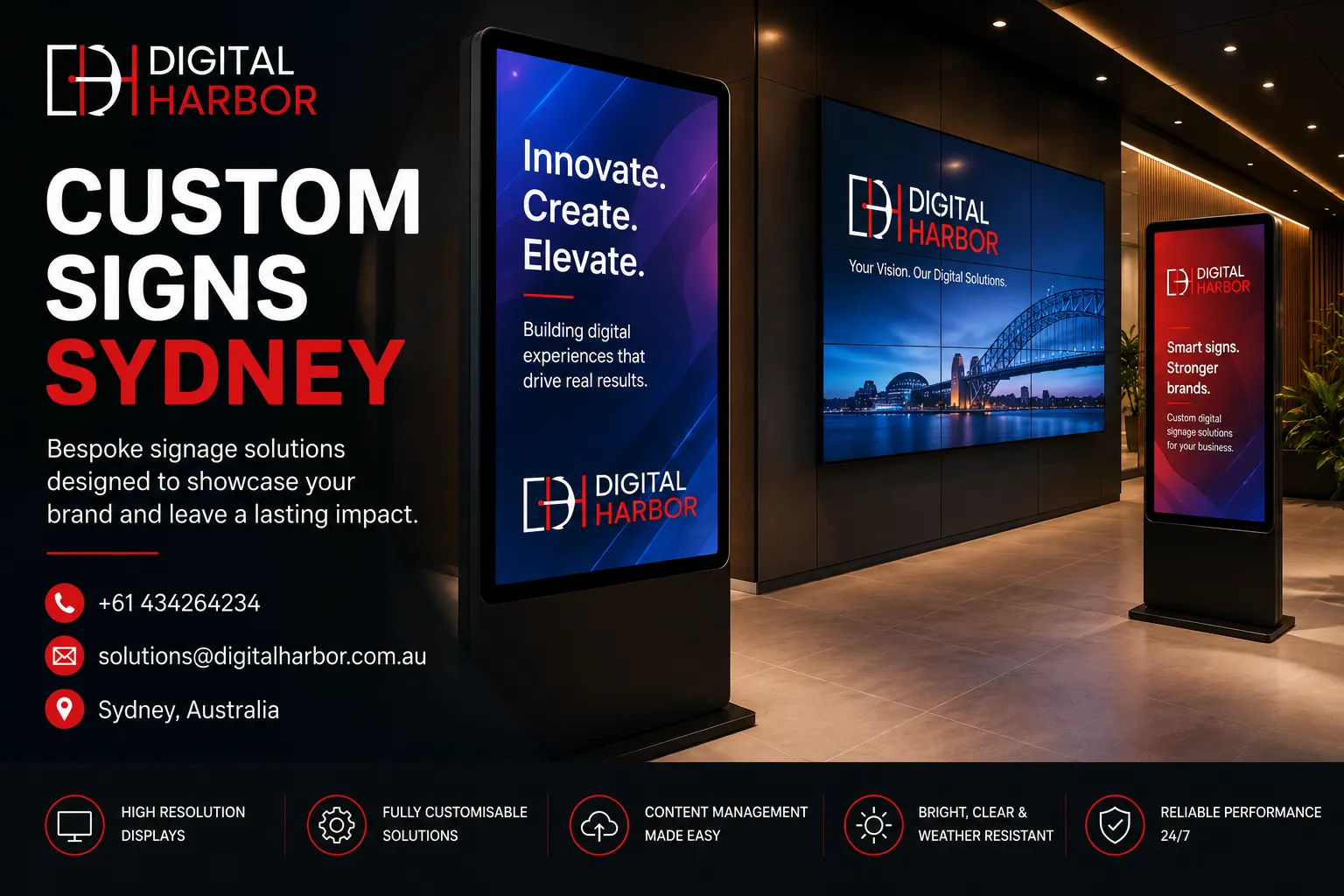
This is the category Digital Harbor focuses on, building and installing LED display signage and digital screens designed specifically for Sydney's retail, hospitality, and commercial environments.
3. Hybrid Signage Solutions
Many businesses combine a traditional illuminated fascia sign with a smaller digital screen inside the window. From what I've observed, this hybrid approach tends to perform best for small to mid-size retailers who want brand permanence outside and flexibility inside.
Custom Signs vs Off-the-Shelf Signs: A Quick Comparison
| Factor | Custom Signage | Off-the-Shelf Signage |
|---|---|---|
| Brand alignment | Built to match your exact branding | Generic templates |
| Sizing flexibility | Tailored to your space | Fixed standard sizes |
| Content control | Can be updated remotely (digital) | Static, requires reprinting |
| Council compliance | Designed with local regulations in mind | May not meet specific zone rules |
| Long-term cost | Higher upfront, lower replacement frequency | Lower upfront, frequent reprints |
| Visual impact | Distinct, hard to replicate | Easily blends in with competitors |
How to Choose the Right Custom Sign for Your Business
Step 1: Define the Job the Sign Needs to Do
Is it for brand recognition? Driving foot traffic? Displaying a changing menu? Each goal points to a different solution. A medical clinic doesn't need the same signage as a busy food court kiosk.
Step 2: Assess Your Location
Sunlight exposure, viewing distance, and foot traffic patterns all affect what kind of display will actually work. A screen that looks great indoors can wash out completely in direct daylight if it's not built for outdoor brightness levels.
Step 3: Decide Between Static and Digital (or Both)
If your offers or information change often, a static sign becomes expensive to maintain. A digital signage display solves that problem by letting you push new content remotely, often from a phone or laptop.
Step 4: Check Council and Strata Requirements
Sydney councils have specific rules around signage size, illumination, and placement, especially in heritage areas and shopping strips. This is one step business owners frequently skip, and it's the one most likely to cause delays.
Step 5: Plan for Installation and Support
A sign is only as good as its installation. Loose mounting, poor weatherproofing, and badly run cabling cause more problems than any design flaw ever will.
Common Mistakes I've Seen Businesses Make
- Choosing size based on budget, not visibility. A sign too small to read from the street is a wasted investment regardless of how well it's designed.
- Ignoring sunlight and glare. Outdoor digital displays need adequate brightness (measured in nits) to remain visible at midday.
- Skipping council checks. Council rejections after installation are costly and avoidable.
- Treating signage as a one-time purchase. Digital signage in particular benefits from ongoing content updates, not a "set and forget" approach.
- Overcomplicating the message. The best signs communicate one clear idea fast. Cluttered signs lose people in seconds.
Best Practices for Custom Signage That Actually Performs
- Keep text minimal. Aim for one core message per screen or panel.
- Use high-contrast colours that match your brand but remain legible from a distance.
- For digital signage, rotate content every 8 to 15 seconds. Longer than that and people stop watching.
- Match brightness to environment. Indoor displays need far less brightness than direct-sunlight outdoor units.
- Schedule seasonal or promotional content in advance so your signage never looks outdated.
Checklist: Before You Order a Custom Sign
- Defined the primary goal of the sign (branding, promotion, information, wayfinding)
- Measured the installation space accurately
- Checked council and strata signage rules
- Decided between static, digital, or hybrid signage
- Confirmed outdoor brightness requirements if applicable
- Planned for content updates (if digital)
- Asked about installation timelines and support
Key Takeaways
- Custom signage is built around your specific brand, space, and goals, unlike generic off-the-shelf options.
- Digital display signage offers flexibility that static signs can't match, particularly for businesses with changing offers or menus.
- Council compliance and location assessment are essential steps that are often overlooked.
- Sydney, Melbourne, Brisbane, Perth, and Adelaide businesses all face similar signage decisions, though local council rules vary by city.
- Signage isn't a one-off purchase. It performs best when treated as an ongoing part of your customer experience strategy.
Final Thoughts
After years of watching businesses get this right (and plenty get it wrong), the pattern is consistent. The businesses that treat signage as a strategic decision, not an afterthought, end up with better foot traffic, stronger brand recall, and fewer regrets six months down the line.
If you're weighing up your options for custom signs Sydney wide, or anywhere across Melbourne, Brisbane, Perth, or Adelaide, it's worth starting with a clear picture of what the sign actually needs to achieve before getting into materials or formats. Digital Harbor works through exactly that process with businesses across Australia, from static shopfront signage through to fully custom LED display signage and digital menu boards. Whether you're after a single window display or a complete video wall installation, Digital Harbor can help map out what fits your space and your goals.
Good signage doesn't shout. It just gets noticed by the right people, at the right moment, every single day.