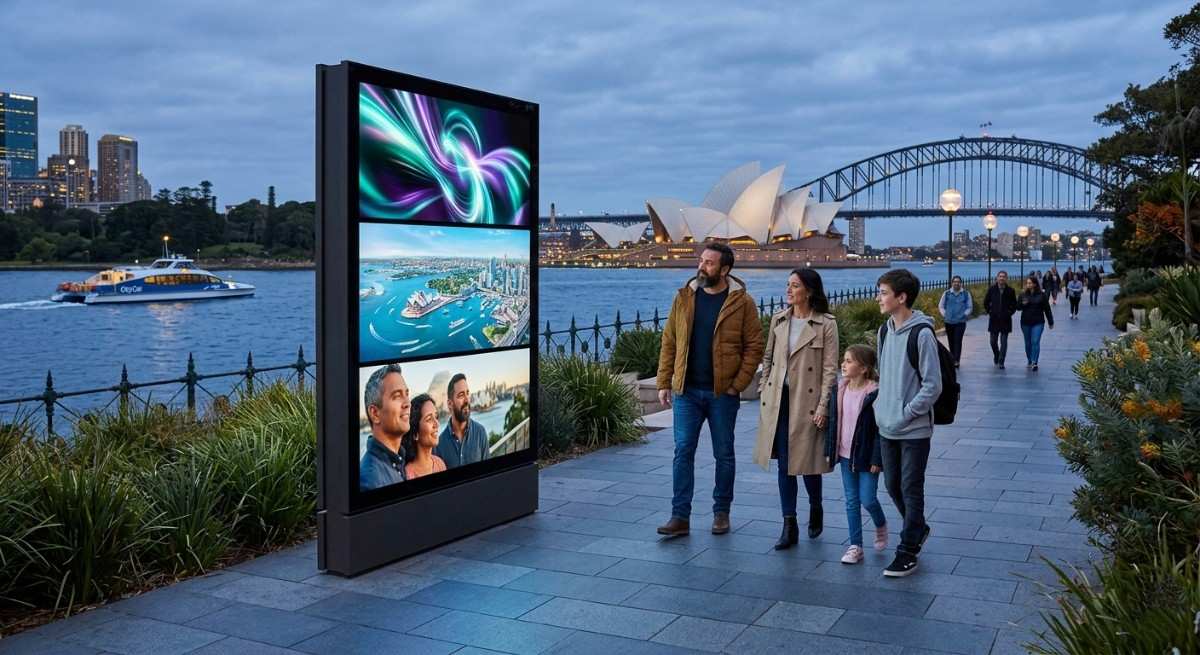
Commercial digital displays in Sydney have moved well past being a luxury for big brands. A family-owned pharmacy in Parramatta, a boutique gym in Surry Hills, a legal firm in the CBD. These are the kinds of businesses now running smart digital signage, and they're doing it because it works.
Whether you're completely new to digital signage or ready to expand what you already have, this is the practical, no-fluff guide you've been looking for.
The Real Case for Commercial Digital Displays in Sydney
Sydney is one of the most competitive commercial environments in the country. High rents, dense foot traffic, and customers who have seen it all. Standing out takes more than a good product. It takes smart presentation.
A report by the Digital Signage Federation found that digital displays capture 400% more views than static signage. That's not a marginal improvement. That's a completely different level of visibility.
I've noticed that businesses in high-footfall Sydney locations like Pitt Street, Darling Harbour, and Chatswood treat their digital signage the same way they treat their website: as a 24/7 sales and communication tool, not just decoration.
The businesses that think of their screens as decoration get decoration-level results. The ones that think strategically get something much more useful.
Understanding What "Commercial Grade" Actually Means
This is a term that gets thrown around a lot. But it matters more than most people realise when you're buying digital displays for a business environment.
Commercial-grade displays are built differently from consumer screens in three key ways:
- They're designed to run continuously, often 16 to 24 hours a day, without degrading
- They have significantly higher brightness levels, measured in nits, which makes them readable in sunlit environments
- They come with robust warranties, better panel longevity, and remote management capabilities that consumer TVs simply don't offer
When I tried using a consumer-grade screen for a window display setup, it washed out completely in afternoon sun and the panel showed burn-in within six months. Commercial displays are built to avoid exactly these problems.
If a provider is offering you a screen at an unusually low point without clarifying that it's commercial grade, ask the question directly.
Types of Commercial Digital Displays Available in Sydney
Sydney's commercial environments vary enormously, and the right display type depends on what you're trying to achieve and where you're placing it.
Digital Window Displays
Designed to sit behind or within shopfront glass and remain clearly visible from the street, even in bright daylight. These work brilliantly on busy Sydney strips like Oxford Street, King Street Newtown, or any suburban shopping precinct where catching a passerby's eye is the whole game.
The content running on a window display should be bold and fast. You have about two seconds to earn a glance from someone walking past.
Digital Menu Boards
The hospitality sector across Sydney has embraced digital menu boards faster than almost any other industry. Walk through Surry Hills, Newtown, or Barangaroo and you'll see them everywhere.
The operational advantages are significant:
- Update pricing, specials, and availability in real time with no printing
- Schedule different menus for breakfast, lunch, and dinner automatically
- Use high-quality food imagery to drive impulse purchases
- Keep the venue looking current and professional without regular redesigns
Video Wall Displays
Multiple screens tiled together into one seamless large-format display. You'll find these in Sydney hotel lobbies, flagship retail stores, corporate reception areas, and entertainment venues.
In my experience, video walls have a psychological effect that single screens simply can't replicate. When a customer walks into a space and sees a properly configured video wall, their perception of the brand shifts immediately. It communicates investment, quality, and seriousness.
Interactive Digital Displays
Touchscreen technology built for customer engagement. Product configurators in retail, wayfinding in large commercial buildings, self-service kiosks in healthcare settings. Sydney's corporate and retail sectors are increasingly deploying these to reduce staff workload while improving the customer experience.
Outdoor and Portable Digital Displays
Built to handle UV exposure, humidity, and the kind of heat Sydney summers deliver. Outdoor commercial displays need weatherproofing and brightness ratings that indoor screens simply aren't built for.
Portable options are popular with drive-through businesses, outdoor dining precincts, and events-based operators who need flexibility without permanent installation.
Choosing the Right Commercial Digital Display Provider in Sydney
The screen is only part of what you're buying. The provider relationship matters enormously, especially if you're deploying across multiple sites or relying on remote content management.
Here's what to genuinely evaluate when comparing providers:
- Do they offer end-to-end service? Consultation, hardware supply, installation, content management setup, and ongoing support should all be on the table. Fragmented service arrangements create gaps.
- What does their content management system look like? You should be able to update your screens remotely from a phone or desktop. Ask for a live demo before committing.
- Can they show real installations? Not renders, not mockups. Actual photos of commercial digital displays they've installed in Sydney or elsewhere in Australia.
- How do they handle hardware failure? Screens in commercial environments are working assets. You need to know what the support process looks like when something goes wrong.
- Do they understand your industry? A provider who has worked with Sydney hospitality venues understands menu board logic. A provider with retail experience understands promotional content cycles. Industry fit matters.
Digital Harbor has built its reputation on exactly this kind of complete, consultative approach. From the first conversation through to installation and beyond, the goal is a signage system that actually performs, not just a screen on a wall.
Where Commercial Digital Displays Work Best in Sydney
Sydney's commercial geography is diverse. The display strategy that works in a CBD tower lobby is different from what works in a western suburbs gym.
CBD and Inner-City Commercial Spaces
High foot traffic, sophisticated audiences, and premium real estate. In these environments, screen quality and content quality both need to be exceptional. Bright panels, sharp resolution, and well-designed content are non-negotiable. A poorly executed display in a CBD location can actually damage brand perception.
Suburban Retail and Hospitality
Volume and relevance matter here. Screens need to communicate offers, menus, and promotions clearly and quickly to a high-volume, time-poor audience. Simplicity wins.
Corporate and Professional Services
Reception areas, meeting rooms, and office common areas. These environments use digital displays for a different purpose: culture, communication, and brand impression. Less promotional, more experiential.
Healthcare and Wellness
Waiting rooms in medical centres, pharmacies, and wellness clinics across Sydney are increasingly using digital displays to share health information, reduce perceived wait times, and promote available services. I've noticed that patients in these environments engage meaningfully with well-curated health content while they wait, which creates a genuine service benefit, not just a marketing one.
Making Your Commercial Digital Display Investment Work
Getting the hardware right is step one. Making it perform over time is the ongoing work.
A few things that genuinely move the needle:
Commit to a content schedule. A screen showing the same content for three months becomes wallpaper. Build a simple monthly content calendar and stick to it.
Match your message to the moment. Use scheduling to show morning content in the morning, lunchtime promotions at lunch. Commercial digital signage software makes this straightforward once you've set it up.
Track what drives action. If you run a promotional offer on screen, measure whether it moved sales. Digital Harbor's platform gives you the ability to manage multiple screens remotely and adjust content based on what's actually working.
Think about ambient lighting. A screen positioned against a bright window or under strong ceiling lights needs a higher brightness spec than one in a dimmer corridor. Get the environment assessment right from the start.