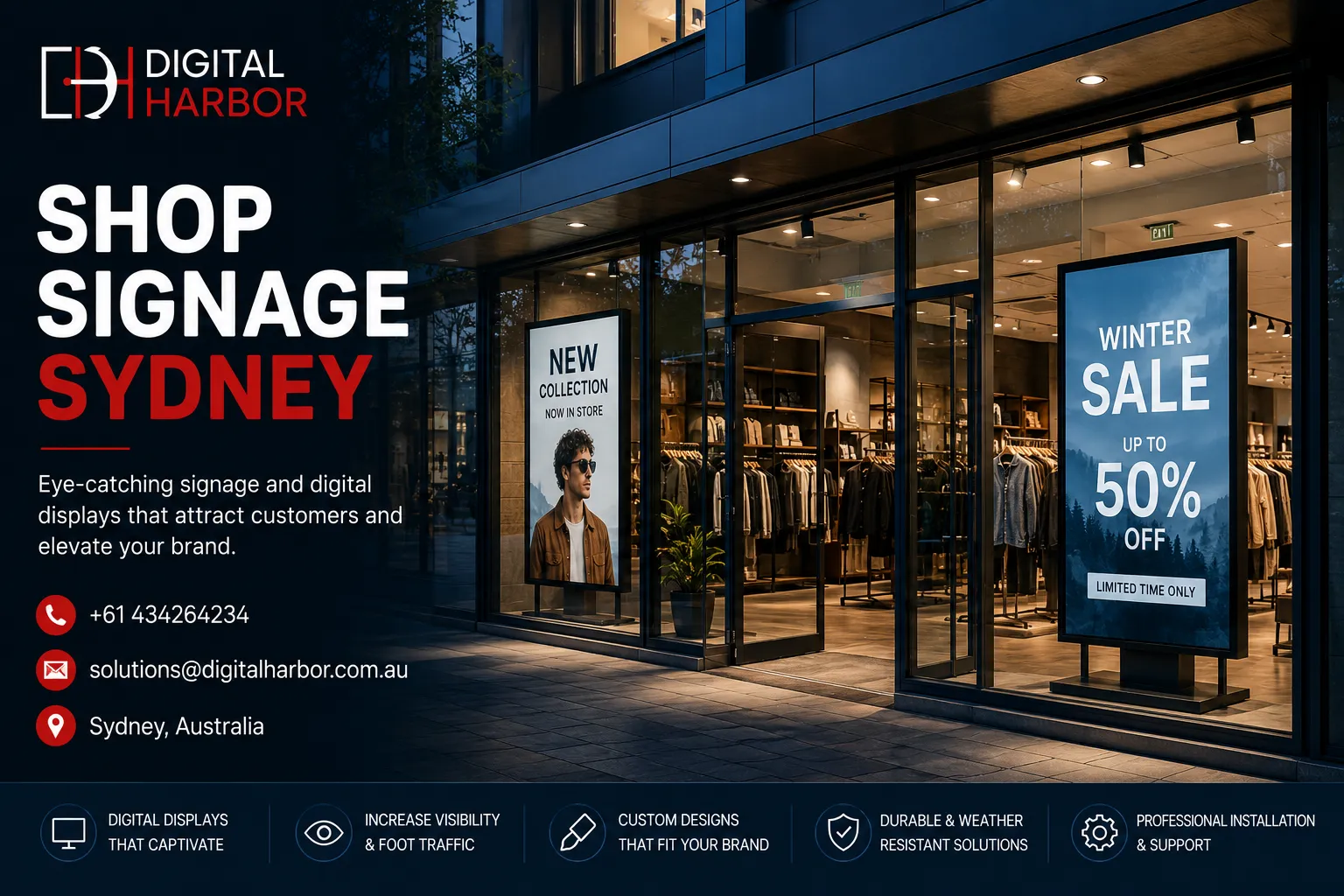
I've spent years helping retailers, cafes, and small hospitality venues rethink their signage, and one pattern keeps showing up. Owners focus on stock, staff, and styling, then treat the sign as an afterthought. That's backwards. Your sign is often the first and only impression a passerby gets before deciding whether to step inside.
This guide covers everything you need to know about shop signage in Sydney, from the basics of choosing a sign through to the role digital displays and menu boards now play in driving foot traffic and sales.
Why Shop Signage Still Matters in a Digital-First World
It's easy to assume signage has taken a backseat now that everyone finds businesses through Google or Instagram. In my experience, that's only half true. Online discovery gets people to your street. Your signage decides whether they actually come in.
I've noticed something consistent across the cafes and retail clients I've worked with: foot traffic spikes noticeably whenever signage gets upgraded, even when nothing else about the business changes. The product is the same. The staff are the same. Only the sign is different, and the results shift anyway.
This isn't just anecdotal. Cornell University's hospitality research has found that visual displays in queue or waiting environments can reduce how long a wait feels to customers, even when the actual wait time hasn't changed. That perception gap matters enormously for retail and hospitality businesses where impatience often costs you the sale before it even happens.
What Counts as Shop Signage Today?
Shop signage covers a broad category, and it's worth breaking down because the right choice depends entirely on what your business needs to communicate.
Static Signage
This includes fascia signs, pylon signs, window decals, and illuminated lettering. These establish identity. They tell people who you are at a glance.
Digital Signage
This is where shop signage has changed the most over the past few years. Digital display for restaurant spaces, retail shopfronts, and service businesses now commonly includes:
- Window-mounted digital displays
- Digital menu boards for cafes and food outlets
- Interactive touchscreens for product browsing
- Video walls for high-traffic retail locations
- Custom LED panels sized to fit unusual shopfronts
When I worked with a café client transitioning from a printed menu to an electronic menu board, the change wasn't dramatic on the surface. Same prices. Same items. But the ability to highlight specials, rotate seasonal items, and adjust visuals throughout the day made a noticeable difference in how customers interacted with the counter area.
Digital Menu Boards: Why So Many Cafes and Restaurants Are Switching
If there's one category within shop signage that's grown faster than any other, it's the digital menu board. And there's a reason for that beyond aesthetics.
Printed menus are static by nature. Once they're printed, every price change, seasonal swap, or sold-out item becomes a logistics problem. Digital menu screens solve that instantly. Updates push live in seconds, often from a tablet or laptop behind the counter.
From what I've observed, the bigger shift isn't operational, it's behavioural. Customers read digital display for restaurant menus differently than printed ones. Motion, rotating specials, and food imagery draw attention to specific items in a way static print simply can't replicate. Cornell's research into menu design and customer decision-making backs this up. Where an item sits and how it's visually presented genuinely shapes what people order.
Common Use Cases for Digital Menu Boards
- Quick-service counters needing fast-reading layouts
- Cafes rotating breakfast, lunch, and seasonal specials
- Bars displaying drink specials and happy hour windows
- Bakeries showcasing daily-made items with imagery
Static vs Digital Shop Signage: A Practical Comparison
| Factor | Static Signage | Digital Signage |
|---|---|---|
| Update flexibility | Requires reprinting | Updated remotely in seconds |
| Initial setup | Lower upfront effort | Requires installation and setup |
| Visual impact | Fixed, consistent | Dynamic, attention-drawing |
| Best for | Brand identity, permanent signage | Menus, promotions, frequently changing content |
| Maintenance | Minimal | Occasional software and hardware checks |
| Customer engagement | Passive | Higher, especially with motion or interactivity |
How to Choose the Right Shop Signage for Your Business
Step 1: Identify What Changes Often
If your offer, menu, or promotions change weekly, static signage becomes a constant cost. A digital solution removes that friction almost entirely.
Step 2: Think About Viewing Distance
A sign that reads perfectly from two metres away might be unreadable from across the street. Match your signage size and font weight to how far away most people will actually be standing.
Step 3: Factor In Your Shopfront's Lighting
Direct sunlight, shaded awnings, and indoor lighting all affect how legible a screen or sign appears. This is one of the most overlooked steps, and one I've seen cause real headaches after installation rather than before it.
Step 4: Check Local Council Rules
Sydney councils regulate signage size, brightness, and placement, particularly in heritage areas and busy retail strips. It's worth confirming compliance before finalising any design.
Step 5: Plan for Ongoing Content
Digital signage works best when it's actively managed. A screen running the same static image indefinitely loses most of its advantage over a printed sign.
Common Mistakes Shop Owners Make With Signage
- Treating signage as a one-time job. Especially with digital menu boards, content needs regular updates to stay effective.
- Choosing screen size based on the shopfront, not the customer's viewing angle. A screen that fits the wall doesn't always fit the sightline.
- Overloading menu boards with too many items. Cluttered menus slow decision-making rather than speeding it up.
- Ignoring glare and sunlight exposure. A beautifully designed display is useless if it's unreadable at midday.
- Skipping council checks before installation. This causes delays and, occasionally, costly removals.
Best Practices for Effective Shop Signage
- Keep your core message visible within the first three seconds of viewing.
- For digital menu screens, limit visible items to a manageable number rather than cramming the full menu onto one board.
- Use consistent fonts and colours across static and digital signage so your brand feels unified.
- Rotate digital content on a schedule rather than leaving it static once installed.
- Test legibility at different times of day, since lighting conditions change how a sign actually appears.
Checklist: Setting Up Shop Signage That Works
- Identified what content needs frequent updates
- Measured viewing distance from likely customer positions
- Checked shopfront lighting conditions throughout the day
- Confirmed council signage requirements
- Chosen between static, digital, or hybrid signage
- Planned for ongoing content management (if digital)
- Reviewed font size and contrast for legibility
Key Takeaways
- Shop signage Sydney businesses choose should be based on what content needs to stay flexible versus what stays fixed.
- Digital menu boards and electronic menu boards give cafes and restaurants real-time control over pricing, specials, and seasonal items.
- Viewing distance, lighting, and council compliance are the three most commonly overlooked factors during setup.
- Digital signage performs best when actively managed, not installed and left untouched.
- Whether you're in Sydney, Melbourne, Brisbane, Perth, or Adelaide, the core principles of effective shop signage stay consistent even as local council rules vary.
Final Thoughts
Shop signage isn't a decoration. It's one of the few parts of a retail or hospitality business that works constantly, without needing a single staff member to manage it day to day, provided it's set up properly in the first place. Whether that means a well-placed fascia sign or a fully managed digital menu board running specials throughout the day, the goal stays the same: make sure people notice you before they've decided where else to go.
Digital Harbor works with retailers, cafes, and hospitality venues across Sydney and beyond to build signage and digital display solutions that actually fit how each business operates day to day. From static shopfront signage through to fully custom digital menu screens, Digital Harbor focuses on practical setups that hold up under real foot traffic, not just on paper.
Good shop signage rarely shouts for attention. It simply makes sure the right people notice, at the right moment, without you having to think about it twice.