But the market is crowded, the jargon is thick, and the stakes are real. A wrong purchase can cost thousands and deliver very little. A right one can genuinely transform how your audience experiences your brand, your space, or your message.
This guide cuts through the noise.
What Is an LED Screen Display?
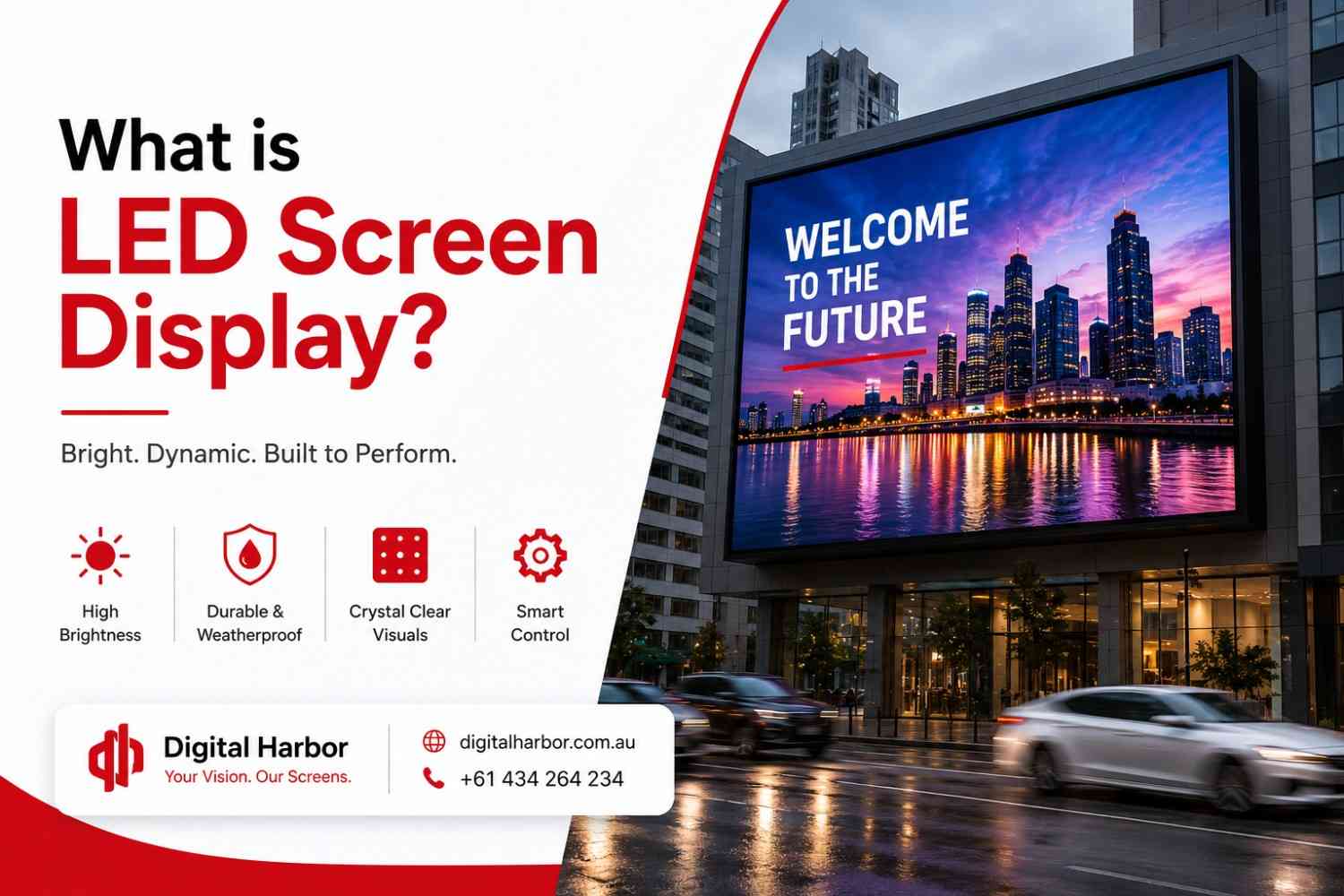
An LED screen display uses an array of light-emitting diodes to produce images, video, text, and animations. Each LED acts as a tiny pixel. Group thousands or millions of them together, control the colour and brightness of each one individually, and you get a full-colour, dynamic visual display capable of producing stunning content in almost any lighting condition.
It sounds simple because the underlying concept is. What makes LED technology compelling is the combination of brightness, efficiency, longevity, and scalability that no other display technology has matched.
Unlike LCD screens, which use a backlight shining through a liquid crystal layer, LED displays produce light directly from each pixel. This is why they can achieve higher contrast ratios, deeper blacks, and that characteristic vivid punch that makes content leap off the screen.
I've noticed that people who see a high-quality LED screen display up close for the first time often describe the same reaction: they didn't realise a screen could look that good in real life.
How LED Display Technology Actually Works
At the most basic level, each pixel in a full-colour LED display is made up of three individual LEDs: one red, one green, and one blue. By varying the intensity of each colour independently, the display can reproduce virtually any colour in the visible spectrum.
The controller sends data to each pixel telling it exactly what colour and brightness to display at any given moment. At a refresh rate of 1,920 times per second or higher, this happens so fast that your eyes perceive smooth, continuous motion even in fast-moving video content.
Direct LED and SMD (Surface Mounted Device) configurations are the two most common in commercial displays. SMD packages all three colour diodes into a single compact component, allowing for much finer pixel pitches and smoother image quality at close viewing distances. Direct LED is more common in large-format displays designed for longer viewing distances.
The more recent COB (Chip on Board) technology encapsulates multiple chips directly onto a circuit board, producing even greater durability and improved performance in demanding environments.
The Main Types of LED Screen Displays
Understanding the landscape of available display types helps you narrow down exactly what you need before you start comparing products.
Indoor LED Screen Displays
Indoor LED displays are optimised for controlled lighting environments. They typically feature finer pixel pitches, ranging from P1.2 to P4, which produces sharp, detailed imagery at close viewing distances. Brightness levels sit between 800 and 1,500 nits, which is more than adequate indoors while keeping heat output and energy consumption manageable.
Common indoor applications include:
- Corporate boardrooms and lobbies: Brand displays, live data dashboards, welcome signage
- Retail stores: Promotional displays, product showcases, atmospheric visual content
- Hospitality venues: Menu boards, event listings, entertainment screens
- Healthcare facilities: Wayfinding, queue management, patient information screens
- Education: Lecture theatre displays, campus information boards, interactive learning walls
Outdoor LED Screen Displays
Outdoor LED displays are an entirely different engineering proposition. They need to push through direct sunlight, survive rain, dust, temperature extremes, and in coastal locations, salt air. Brightness levels typically start at 3,000 nits and can exceed 10,000 nits for the most demanding environments.
Weatherproofing to at least IP65 is non-negotiable for any permanently installed outdoor display. Structural integrity, wind load ratings, and thermal management are equally critical.
LED Video Walls
A video wall assembles multiple LED panels into a single large display surface. Modern LED video walls use ultra-narrow bezel or bezel-free tile designs that make the joins between panels virtually invisible at normal viewing distances.
Video walls scale to almost any size and can be configured in non-standard shapes, curves, and even three-dimensional installations. They're the go-to choice for flagship retail environments, broadcast studios, control rooms, and major event spaces.
Transparent LED Display Screens
Transparent LED displays are one of the most visually arresting applications of the technology. The display is constructed with enough spacing between LED modules that it maintains partial transparency, allowing viewers to see through the screen while content plays on it.
When I tried demonstrating a transparent LED display to a retail client for the first time, the response was immediate. They described it as looking like content floating in mid-air. The effect is compelling, and for window-facing retail or architectural installations, it's genuinely hard to replicate with any other technology.
Typical transparency ratings range from 70% to 95%, depending on the pixel pitch and module density.
Flexible and Curved LED Displays
LED technology lends itself to flexible configurations in a way that glass-based display technologies simply cannot match. Flexible LED panels can be curved, wrapped around columns, shaped into cylinders, or even installed on irregular surfaces.
This opens up creative possibilities that were previously the exclusive domain of major brand installations with enormous budgets. The technology has become far more accessible in recent years.
Rental and Events LED Screens
The events industry relies heavily on modular LED screen display systems that can be assembled quickly, transported efficiently, and configured differently for each event. Lightweight aluminium frames, snap-lock panel connections, and robust flight cases are standard features of event-grade LED display systems.
Key Technical Specifications Explained
The spec sheet for an LED screen display can look intimidating. Here's what the important numbers actually mean in practice.
Pixel Pitch
Pixel pitch is the measurement in millimetres between the centres of adjacent pixels. It is the single most important specification for determining image quality at a given viewing distance.
The general formula: minimum viewing distance in metres roughly equals the pixel pitch in millimetres. So a P3 display looks its best from 3 metres or further. At shorter distances, individual pixels become visible. At greater distances, the resolution is more than adequate.
Brightness
Measured in nits (candelas per square metre), brightness determines visibility across different lighting conditions. A rough guide:
- Indoor ambient light: 800 to 1,500 nits
- Semi-outdoor or window-facing: 2,000 to 3,500 nits
- Full outdoor shaded: 3,500 to 5,000 nits
- Full outdoor direct sunlight: 5,000 to 10,000 nits
Automatic brightness control through ambient light sensors is a feature worth prioritising. Running a screen at maximum brightness when conditions don't require it wastes energy and shortens panel lifespan unnecessarily.
Refresh Rate
Refresh rate is how many times per second the display updates its image. For smooth video and motion graphics, 1,920Hz is the practical minimum. For installations where the screen will be regularly photographed or broadcast, look for 3,840Hz or higher to avoid flicker artefacts in camera footage.
Contrast Ratio
Contrast ratio describes the difference between the brightest white and the darkest black a display can produce. Higher contrast ratios produce richer, more vivid imagery. LED displays with good black masking technology can achieve contrast ratios that LCD technology cannot match.
Viewing Angle
Commercial LED displays typically offer viewing angles of 140 degrees horizontal and 140 degrees vertical or wider. This matters in any environment where viewers approach from different directions, such as retail floor displays, transit hubs, or large venue installations.
Choosing the Right LED Screen Display for Your Application
Working through a structured decision process saves time, avoids costly mismatches, and produces better outcomes.
Start with the environment: Indoor, outdoor, or semi-outdoor? What are the lighting conditions at the worst time of day? What are the temperature and weather exposure levels?
Define your viewing distance: Who is your primary audience and how far will they typically be from the screen? This immediately narrows your pixel pitch options.
Clarify your content type: Static graphics, animated content, live video, real-time data feeds? Higher motion content demands higher refresh rates. Real-time data integration requires specific CMS and connectivity capabilities.
Establish your operational hours: Will the screen run 24 hours a day, during business hours only, or seasonally? Operational hours directly affect which panel grades and cooling configurations are appropriate.
Consider the installation environment: Is there sufficient structural support? Is power access adequate? Is there room for rear service access, or is front-service access required?
Evaluate content management needs: How will content be created, scheduled, and updated? Who will manage it day-to-day? A sophisticated screen paired with a CMS that nobody in the organisation can actually use is a frustrating and wasteful combination.
The team at Digital Harbor works through exactly this kind of structured process with every client before recommending a specific display configuration. The right answer genuinely depends on the full picture of how and where the screen will be used.
LED Screen Display Applications Across Industries
Retail
Retail is one of the most dynamic environments for LED screen displays. Dynamic in-store content has been shown in multiple studies to increase dwell time, drive impulse purchases, and improve brand perception. A 2022 study by the Digital Signage Federation found that digital displays in retail environments can increase overall sales volume by up to 33% when content is relevant and well-targeted.
Window-facing high-brightness displays and in-store video walls are increasingly standard in flagship retail. Even mid-sized independent retailers are finding accessible entry points into the technology.
Corporate and Commercial
Office lobbies, corporate headquarters, and multi-tenanted commercial buildings use LED screen displays for brand expression, visitor management, internal communications, and environmental enhancement. A well-designed lobby display communicates organisational culture before a visitor has spoken to a single person.
Hospitality and Food Service
Digital menu boards, promotional screens, and atmospheric display content have become standard across everything from quick service restaurants to high-end hotels. The ability to change menu pricing, highlight seasonal items, or swap promotional content instantly, without reprinting anything, is a practical benefit that hospitality operators particularly value.
Events and Entertainment
From music festivals to corporate conferences, LED screen displays are central to the live experience. Large-format IMAG (image magnification) screens allow audiences at the back of a venue to feel connected to what is happening on stage. Custom-shaped and themed LED installations are now a standard element of event production.
Transport and Public Infrastructure
Airports, train stations, bus terminals, and ferry wharves use LED screen displays for timetable information, wayfinding, safety communications, and advertising. The combination of high brightness, reliable continuous operation, and remote content management makes LED technology the default choice for transit infrastructure globally.
Installation Considerations You Cannot Afford to Skip
In my experience, the projects that run into trouble almost always trace the root cause back to installation planning that was either rushed or skipped entirely. Here is what needs to be resolved before a single screen arrives on-site.
Structural engineering: LED screen displays are heavy. Large configurations are very heavy. Mounting structures, whether walls, frames, or freestanding supports, need to be engineered for the load, including dynamic wind loads for outdoor installations. In Australia, a structural engineer's certification is typically required for permanent outdoor signage above a certain size.
Electrical infrastructure: Confirm available power capacity, circuit protection, and whether three-phase power is needed. Shared circuits and undersized protection are common causes of display failures that are entirely avoidable.
Network connectivity: Cloud-based content management requires reliable internet access at the installation point. Hardwired ethernet connections are preferable to Wi-Fi wherever possible. For remote or challenging locations, 4G or 5G cellular connectivity provides a reliable fallback.
Cable management: Power and data cables should be routed through conduit, hidden within wall cavities where possible, and protected from physical damage and weather exposure for outdoor runs. Surface-mounted unprotected cabling is both a safety risk and an aesthetic problem.
Ventilation and thermal management: LED displays generate heat. Enclosed installations, recessed mounting configurations, and outdoor enclosures all need to account for heat dissipation. Overheating is one of the leading causes of premature LED display failure.
Compliance and approvals: Depending on your location and the size of the installation, planning permits, building approvals, or council signage consents may be required. Starting this process early is essential. It is not unusual for approval timelines to add weeks or months to a project schedule.
Maintaining Your LED Screen Display
Consistent, proactive maintenance is the difference between a display that performs brilliantly for fifteen years and one that causes headaches within three.
Weekly checks: Scan the display surface visually for dead pixels, colour inconsistencies, or physical damage. Confirm that the CMS is delivering scheduled content correctly.
Monthly tasks: Clean external surfaces with appropriate screen-safe solutions. Check that ventilation fans are operating. Review brightness scheduling to ensure it remains appropriate for seasonal light changes.
Quarterly servicing: Inspect all cable connections and weatherproof seals. Update firmware for media players and CMS platforms. Check power supply components for signs of wear or heat stress.
Annual professional inspection: A thorough inspection by a qualified technician should include checking LED module performance, calibrating colour and brightness uniformity across the display, and inspecting structural fixings and mounting hardware.
Digital Harbor recommends establishing a proactive service agreement at the point of installation rather than waiting for problems to emerge. Reactive maintenance is almost always more expensive and disruptive than scheduled servicing.
An LED screen display is one of the most versatile, durable, and impactful communication tools available to businesses today. Getting the specification right, planning the installation properly, and maintaining the system consistently are what separate a display that delivers real value from one that simply costs money.