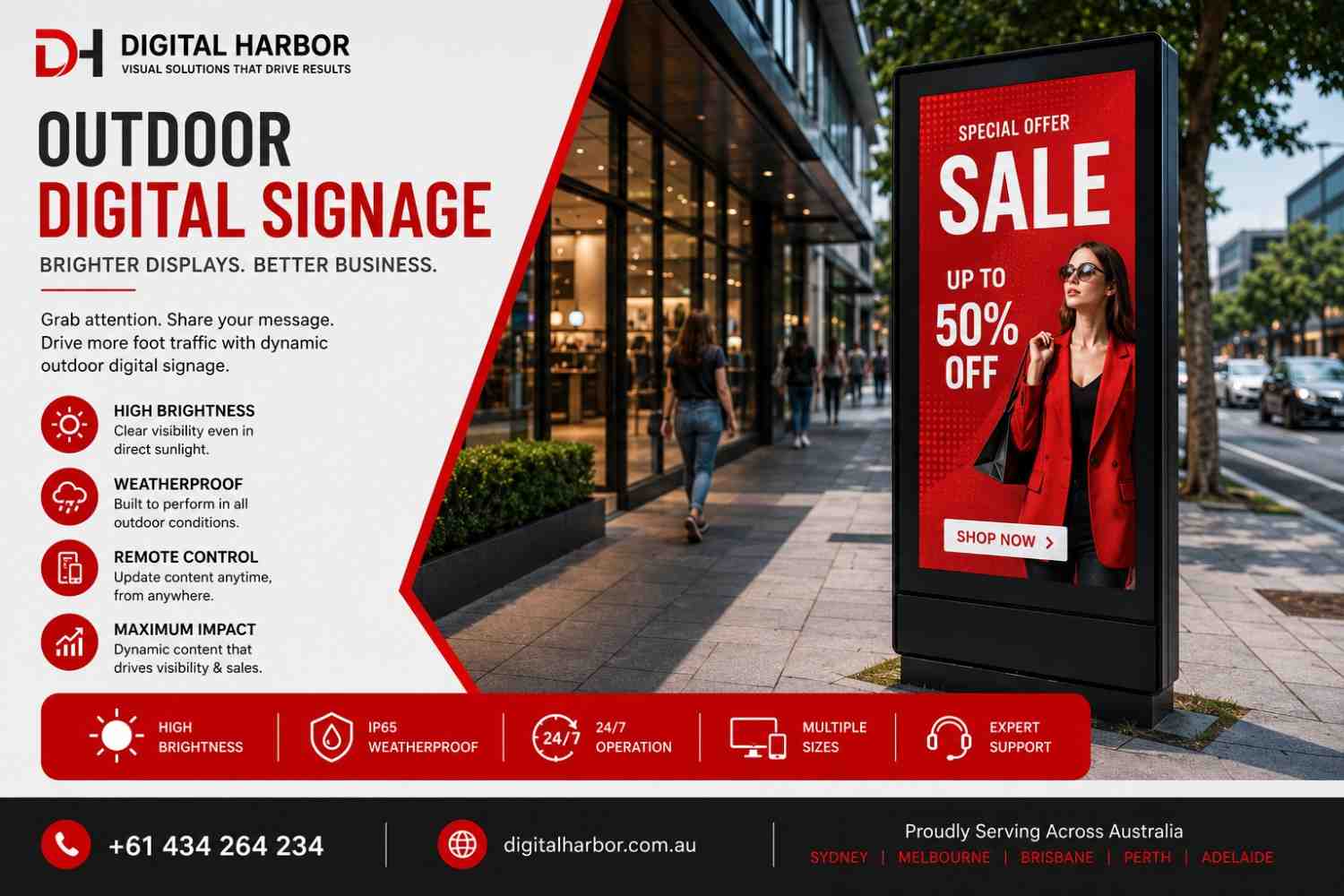
Most businesses spend a fortune on online advertising and forget the one audience they already have standing right outside their door. Outdoor digital signage fixes that. It puts your message directly in front of people at the exact moment they are physically close enough to walk in.
This guide covers everything you need to know about outdoor digital signage, from how it works and what types are available, to what actually makes one installation succeed where another falls flat. Whether you run a single retail store or manage multiple commercial locations, there is something useful here for you.
Why Outdoor Digital Signage Is Different From Everything Else
There is no ad blocker for a street. There is no skip button. When someone walks past your building and a bright, dynamic screen catches their eye, they look. That is the fundamental advantage of outdoor digital signage over almost every other form of advertising available to a local business.
According to the Out of Home Advertising Association of Australia, outdoor advertising reaches over 90% of Australians each week. When you combine that reach with dynamic digital content that can be updated in real time, you have a communication channel that is both broad and precise.
The other thing that makes outdoor digital signage genuinely powerful is context. The person seeing your screen is already near you. They are not scrolling through a feed at home thinking vaguely about lunch. They are outside, possibly looking for exactly what you offer. That physical proximity is worth a lot.
What Makes a Good Outdoor Digital Signage System
This is where most guides gloss over the details. Understanding what separates a solid outdoor display from one that causes problems within a year will save you a significant amount of frustration.
High Brightness Panels
Outdoor environments are unforgiving for screens. Direct sunlight can completely wash out a display that performs beautifully indoors. Outdoor digital signage panels are rated in nits, and for any installation exposed to ambient daylight, you want a minimum of 2500 nits. For installations in direct sun, 5000 nits or higher is the appropriate benchmark.
In my experience, brightness is the single most common area where businesses underspecify and then wonder why their screen looks dim and washed out during peak daylight hours. Get this right from the start.
Weatherproofing and IP Rating
Australian weather is not gentle. Outdoor displays need to handle heat, humidity, rain, dust, and in some regions, salt air from coastal proximity. The IP rating system tells you exactly how well a unit handles these conditions.
IP65 is generally the minimum acceptable rating for outdoor digital signage. It means the unit is fully dust-tight and protected against water jets from any direction. For more exposed installations or coastal locations, look for IP66 or higher.
Thermal Management
Screens generate heat. Direct sun adds more. Without proper thermal management, an outdoor display can overheat, throttle its performance, or shut down entirely during the hottest part of the day, which is often exactly when you most want it running.
Quality outdoor digital signage systems include active or passive cooling designed specifically for the operating temperature range. Always check the rated operating temperature before committing to any outdoor display.
Structural Integrity
Wind, vibration, and physical contact from passersby all put stress on outdoor installations. Mounting hardware, enclosures, and the panels themselves need to be engineered for permanent outdoor exposure. This is not the place to cut corners.
The Different Types of Outdoor Digital Signage
Outdoor signage is not one-size-fits-all. Different environments call for different solutions.
Freestanding Outdoor Displays
These are self-contained units mounted on a post or base, typically positioned near a building entrance, at street level, or within a forecourt or outdoor dining area. They are highly visible from multiple angles and can often be repositioned if your needs change.
When I tried a freestanding outdoor display outside a busy service-facing retail location, the response was almost immediate. Customers referenced specific promotions they had seen on the screen outside. They had not seen any email or social post. Just the screen.
Window-Facing High Brightness Displays
Not all outdoor signage needs to be physically outside. High-brightness displays mounted inside a window and facing outward are technically indoor installations but perform like outdoor signage. They offer the advantage of being protected from the weather while still capturing the attention of pedestrians.
For businesses in retail strips or shopping precincts, this is often the most practical and visually effective option available.
Portable Outdoor Digital Signage
Portable units are designed for flexibility. They are weatherproof, often battery-powered or easy to connect, and can be moved between locations or stored away when not needed. Drive-through restaurants, event venues, markets, and businesses with seasonal outdoor setups are natural fits for portable outdoor digital signage.
The portability factor is underrated. Having the ability to place your display exactly where foot traffic is heaviest on a given day, rather than being locked into a fixed mounting point, is a genuine operational advantage.
Outdoor Digital Menu Boards
Specifically designed for drive-through and outdoor food service environments, these displays are optimised for readability at distance, sunlight visibility, and durability in food service conditions. If you operate any kind of outdoor or drive-through service, a static printed menu board is a version of the problem you can solve.
Large Format Outdoor LED Screens
For high-visibility applications like building facades, car park entrances, major intersections, and large commercial sites, large format outdoor LED screens deliver scale that smaller displays simply cannot match. These are the displays that can be seen from hundreds of metres away and work as both branding and advertising surfaces.
Where Outdoor Digital Signage Delivers the Most Value
Different industries are using outdoor digital signage in quite different ways, and understanding this helps you figure out what approach makes sense for your own situation.
Retail stores use outdoor displays to promote daily deals, clearance events, and new arrivals to pedestrians before they have even decided whether to enter.
Hospitality venues including restaurants, bars, and cafes use outdoor signage to display menus, happy hour promotions, live event listings, and reservation prompts to foot traffic.
Automotive businesses including car dealerships and service centres use outdoor screens to highlight current offers, service specials, and vehicle features to people driving past.
Healthcare clinics and allied health practices use exterior displays for appointment reminders, service information, and health awareness messaging to the local community.
Real estate agencies use outdoor digital displays in their windows and at development sites to showcase listings, virtual tours, and contact information to passers-by.
Educational institutions use outdoor signage for campus wayfinding, event promotion, and community engagement near high-traffic entry points.
How Digital Harbor Approaches Outdoor Digital Signage
Getting an outdoor digital signage installation right requires more than just selecting a screen. It requires understanding the environment, the audience, the content strategy, and the long-term operational needs of the business running it.
Digital Harbor works through a structured consultation process before recommending any hardware. That means assessing the installation environment for sun exposure, wind, viewing angles, and power access before specifying a panel. It means aligning the content management setup with how the client actually wants to operate day to day.
I have noticed that businesses which treat outdoor signage as a set-and-forget installation almost always underperform compared to those that build even a basic content refresh schedule into their operations. The screen is the hardware. The content is what actually does the work.
Digital Harbor serves businesses across Sydney, Melbourne, Brisbane, Perth, and Adelaide, and the team brings that breadth of experience to understanding what works in different Australian commercial environments.
Getting Your Content Right for Outdoor Displays
A common mistake with outdoor digital signage is applying indoor content design thinking to an outdoor screen. Outdoor audiences are moving. They are often viewing from a distance and at an angle. They have seconds, not minutes.
Here is what actually works for outdoor digital signage content:
Keep text minimal. If someone needs to read more than six to eight words to understand your message, it is too much for an outdoor display.
Use high contrast visuals. Bold colours against dark or light backgrounds with strong contrast remain readable across a range of viewing conditions.
Lead with the offer or benefit. Do not build up to the point. Put the most important information at the top and make it large.
Use motion purposefully. Movement draws the eye, but erratic or overly complex animation can be harder to read for a moving audience. Keep motion clean and directional.
Update content regularly. The same static image on an outdoor display for months starts to register as wallpaper to regular passers-by. Fresh content keeps the display working as an active communication channel.
Digital Harbor delivers outdoor digital signage solutions tailored to Australian commercial environments across Sydney, Melbourne, Brisbane, Perth, Adelaide, and surrounding regions. Get in touch to discuss what the right outdoor display setup looks like for your location.