But buying the wrong one is an expensive mistake. And it happens more often than most suppliers will admit.
This guide covers everything from how outdoor LED screens actually work, to what specs genuinely matter, to real installation considerations that most buyers only discover after the fact.
What Makes Outdoor LED Screens Different from Indoor Displays
This is the question that matters most, and it's worth answering properly before anything else.
Outdoor LED screens are engineered from the ground up for hostile environments. We're talking direct sunlight, rain, dust, temperature swings, humidity, and in some locations, salt air or extreme cold. A standard indoor screen placed outside will typically fail within weeks, sometimes days.
Here's what separates a true outdoor display from everything else:
- Brightness: Outdoor screens typically operate between 3,000 and 10,000 nits. On a bright Australian summer day, you need at least 5,000 nits for content to be comfortably readable. Indoor screens rarely exceed 500 nits.
- IP Rating: The Ingress Protection rating tells you how well a screen resists dust and water. For outdoor use, you want a minimum of IP65, which means fully dust-tight and protected against water jets from any direction.
- Operating temperature range: Commercial outdoor panels are built to run in temperatures from roughly minus 20 degrees Celsius up to 60 degrees Celsius, sometimes higher with proper thermal management.
- Structural integrity: Outdoor enclosures use powder-coated aluminium or steel, anti-corrosion hardware, and tempered safety glass or polycarbonate fronts rated for impact resistance.
When I tried comparing side-by-side specs between a consumer television and a commercial outdoor LED screen for the first time, the brightness difference alone was genuinely shocking. It's not a marginal improvement. It's a completely different category of hardware.
Types of Outdoor LED Screens
Fixed Outdoor LED Billboards
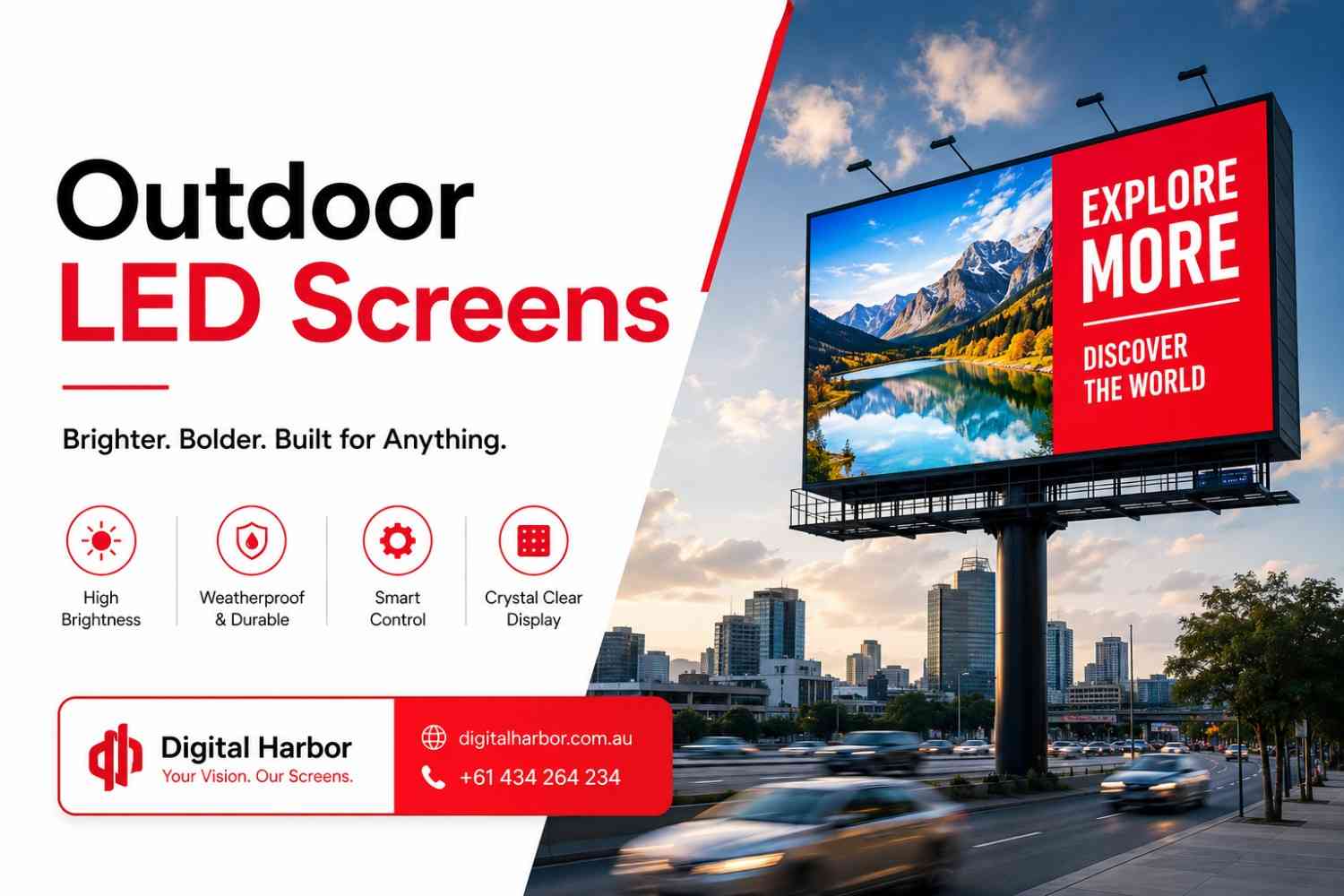
These are the large-format, permanently mounted displays you see on highways, building facades, and major intersections. They're built for continuous 24/7 operation and are typically modular in design, meaning individual LED panels can be replaced without taking down the entire structure.
Pixel pitch on outdoor billboards tends to be larger, often between P6 and P16, because viewing distances are measured in tens or hundreds of metres. At that distance, fine pixel pitch is wasted resolution and unnecessary cost.
Freestanding Outdoor Digital Totems
Totems are self-contained vertical displays mounted in their own enclosure with a base or plinth. They're popular in retail carparks, outdoor shopping precincts, transport hubs, and public spaces. A good totem installation covers 360-degree visibility, built-in ventilation, and often a lockable service panel at the rear.
Outdoor Window-Facing Screens
These sit just inside a window but are designed to be seen from outside. They need high brightness to push through glass reflections and direct sunlight. In my experience, these are one of the most misunderstood product categories because many buyers assume a regular high-brightness screen will work. The glass, the angle of sunlight, and the viewing conditions outside require very specific display configurations.
Outdoor LED Video Walls
For large-scale installations like stadium facades, concert venues, or major retail flagships, modular LED panels are assembled into video walls of almost any size and shape. The technology has advanced to the point where curved installations, wraparound columns, and irregular shapes are entirely achievable.
Portable Outdoor LED Screens
Event organisers, outdoor cinemas, sports clubs, and trade shows often need screens that can be assembled, used, and packed down. Portable outdoor LED systems use lightweight modular panels that slot together quickly and connect to a single controller.
The Specs That Actually Matter
There's a lot of noise in the outdoor LED screen market. Salespeople throw around numbers that sound impressive but don't always translate to real-world performance. Here's what to actually pay attention to.
Pixel Pitch
Pixel pitch is the distance in millimetres between the centre of one LED cluster and the next. Smaller pitch means higher resolution and a sharper image, but it also means higher cost and more LEDs to maintain.
A simple rule of thumb: divide your minimum viewing distance in metres by 1,000 to get an approximate maximum pixel pitch in millimetres. So for a screen viewed from no closer than 8 metres, a P8 screen is the finest resolution you'd realistically need.
Brightness and Dimming
Higher brightness is not always better. A screen that runs at maximum brightness 24 hours a day consumes more power and degrades faster. Look for screens with automatic brightness adjustment that responds to ambient light sensors. On a cloudy night, you don't need 7,000 nits. You need maybe 800. Smart dimming extends panel lifespan and cuts energy costs significantly.
Refresh Rate
Refresh rate affects how smoothly video content plays and, critically, how the screen looks when photographed or filmed. For most general signage applications, 1,920Hz is perfectly adequate. If your screen will frequently be captured on camera or broadcast, look for panels rated at 3,840Hz or higher to avoid moiré patterns and flicker in footage.
Cabinet Design
Modular outdoor LED cabinets come in two main designs: front-service and rear-service. Front-service cabinets allow maintenance access from the front face of the screen, which is essential for wall-mounted or tight-space installations where there's no room behind the screen. Rear-service requires access to the back, which is fine for freestanding or billboard structures.
Mean Time Between Failures (MTBF)
This is a reliability metric that tells you how long the screen's components are expected to run before a failure occurs. For commercial outdoor applications, look for MTBF ratings of 100,000 hours or more. That translates to roughly 11 years of continuous operation under normal conditions.
Real-World Applications of Outdoor LED Screens
Retail and hospitality precincts use outdoor LED displays to drive foot traffic, promote daily specials, and create atmosphere. A well-positioned screen at the entrance to a restaurant strip or shopping centre can serve as a genuine anchor for the space.
Transport hubs including bus terminals, train stations, and ferry wharves rely on outdoor screens for real-time timetable information, safety announcements, and advertising. The combination of functional information with commercial content on the same screen is an efficient use of prime display real estate.
Sporting venues have embraced large-format outdoor LED screens for scoreboards, live match feeds, and fan engagement content. The energy a big outdoor screen adds to a live event atmosphere is hard to replicate any other way.
Corporate campuses and building facades increasingly use outdoor LED screens as brand statements. A full-facade LED installation on an office building or hotel is now within reach for mid-sized organisations, not just multinationals.
According to the Out of Home Advertising Association of Australia, digital out-of-home advertising continues to grow year on year, with outdoor digital formats consistently outperforming static placements in audience recall and engagement metrics.
The team at Digital Harbor has observed this shift firsthand across a range of commercial installations. Clients who upgrade from static to dynamic outdoor displays routinely report stronger audience engagement within the first few weeks of going live.
Installation Planning: What to Sort Out Before Day One
Poor installation planning is the single biggest source of problems in outdoor LED screen projects. Get these sorted before anything arrives on-site.
Structural support: LED screens are heavy. A large-format outdoor display can weigh several hundred kilograms. The mounting structure, whether it's a wall, a pole, a rooftop frame, or a freestanding structure, needs to be engineered to handle both the static weight and dynamic wind loads. In Australia, this typically requires a structural engineer's sign-off.
Power supply: Outdoor LED screens can draw significant power. Confirm your available power supply, whether three-phase power is accessible, and whether a dedicated circuit is needed. Running a screen on an undersized or shared power circuit is a common cause of early failures.
Cabling and connectivity: Plan your cable routes before installation. Signal cables, power cables, and network connections all need to be weatherproofed and protected. Underground cable runs in conduit are far preferable to surface-mounted solutions exposed to the elements.
Planning and council approvals: In most Australian states and territories, illuminated outdoor signage above a certain size requires development approval or signage permits from the local council. This process can take weeks or months. Starting this early is essential, not optional.
Content management infrastructure: Decide how the screen will be managed and updated. Cloud-based CMS platforms allow remote content updates from any device. On-site media players need to be housed in weatherproof enclosures and connected to reliable internet or LAN connections.
Maintaining Outdoor LED Screens for Long-Term Performance
In my experience, the businesses that get the longest life out of their outdoor LED screens are the ones that treat maintenance as routine rather than reactive.
Here's a practical maintenance schedule to follow:
Monthly:
- Visual inspection of the screen surface for dead pixels, discolouration, or physical damage
- Check that ventilation fans or cooling systems are operating
- Clean external surfaces with appropriate non-abrasive cleaning materials
- Review brightness calibration settings
Quarterly:
- Inspect all cable connections for signs of weathering, corrosion, or loosening
- Check the integrity of seals and gaskets on cabinet doors and service panels
- Update CMS software and media player firmware
- Review and adjust automatic brightness schedules seasonally
Annually:
- Full structural inspection of mounting hardware and fixings
- Professional internal inspection of LED modules and power supplies
- Thermal imaging inspection if available, to identify hotspots before they cause failures
- Full content audit to ensure all scheduled playlists are current and functioning
Digital Harbor recommends establishing a service agreement at installation to ensure these checks happen consistently rather than being deferred until something goes wrong.
Choosing the right outdoor LED screen is a significant investment, and the decisions you make at the selection stage affect performance, reliability, and long-term cost for years to come. Take the specs seriously, plan the installation thoroughly, and treat maintenance as part of the package rather than an afterthought.