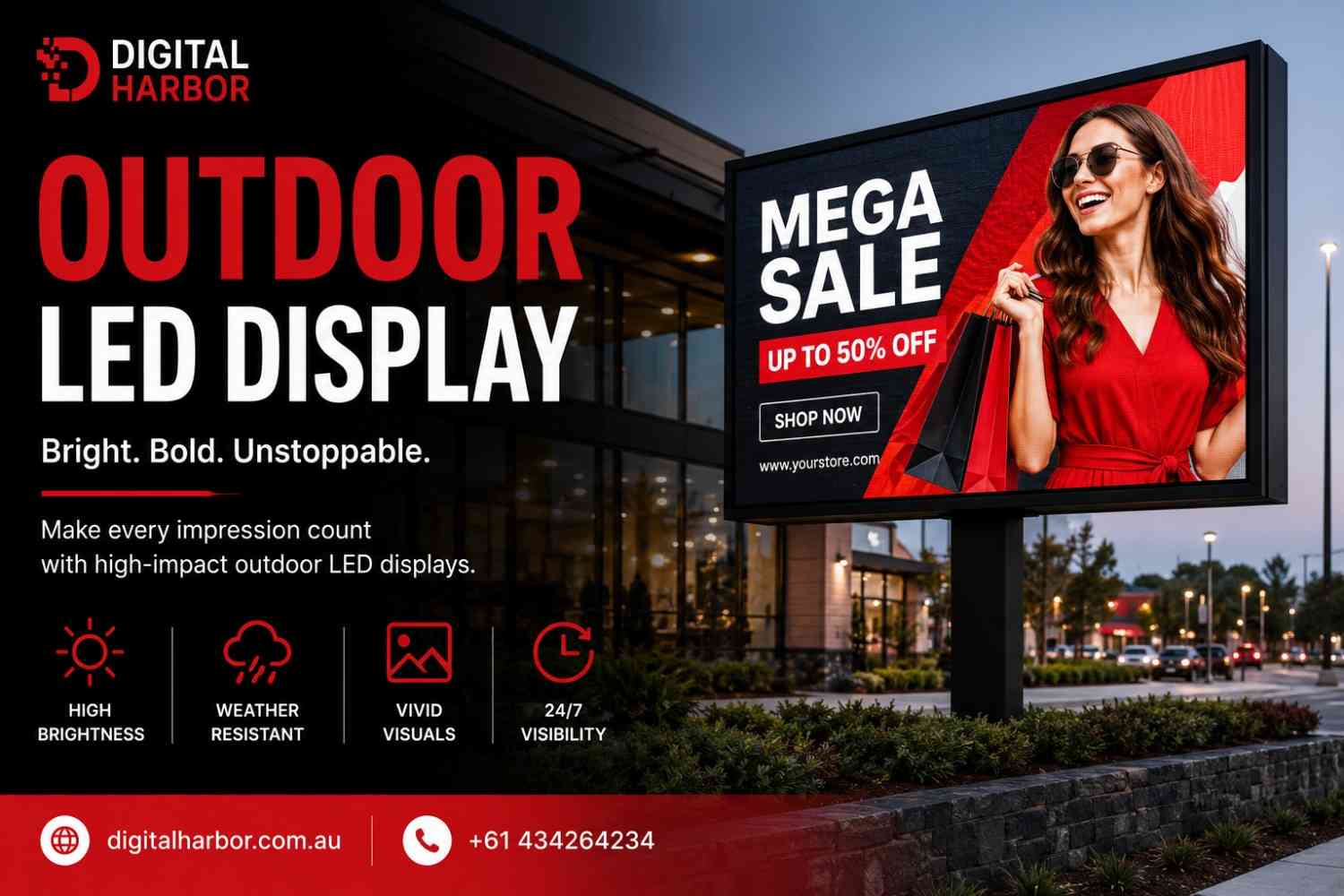
Your business frontage is either working for you or it is not. An outdoor LED display turns passive exterior space into one of the most consistently effective communication tools available to any business with a physical location. It does not sleep. It does not take weekends off. And it reaches people at the exact moment they are close enough to act on what they see.
This guide covers everything you need to know about outdoor LED displays in the Australian context. What makes them different from indoor screens, which types suit which environments, how to read the specifications that actually matter, and what separates a high-performing installation from one that disappoints within the first season. All of it based on genuine experience across Australian commercial environments.
Why an Outdoor LED Display Is in a Category of Its Own
There is no other advertising or communication format that combines always-on visibility, dynamic content capability, real-time updateability, and physical proximity to your audience the way an outdoor LED display does.
A billboard reaches people who are passing. A social media ad reaches people who are scrolling. An outdoor LED display reaches people who are already physically near your business, already in the decision-making window for whatever you offer, and already in an environment where they can act immediately on what they see. That combination is genuinely rare in marketing.
According to research by the Outdoor Media Association of Australia, outdoor advertising as a category delivers one of the lowest costs per thousand impressions of any media format available to Australian businesses. When you factor in the dynamic content capability of an outdoor LED display, which allows you to push real-time offers, daypart-specific messaging, and immediate promotional updates, the performance gap between outdoor LED and static alternatives widens further.
In my experience, the most common reaction from business owners after their first outdoor LED display goes live is that they wish they had installed one years earlier. The visibility uplift is immediate and observable. Customers come in referencing things they saw on the screen. Foot traffic responds. The return on investment becomes tangible quickly.
What Separates an Outdoor LED Display From Everything Else
It is worth understanding why outdoor LED displays are built differently from indoor screens, because those differences directly affect what you should specify and what you should be willing to pay for.
An outdoor LED display operates in conditions that would destroy an indoor screen within weeks. Direct UV radiation, rain, dust, humidity, salt air in coastal environments, temperature swings from cold overnight lows to extreme afternoon heat. Every one of these variables needs to be engineered into the design of the unit.
Australian conditions add additional demands to this list. UV intensity in Australia is among the highest in the world. Ambient temperatures in Queensland, Western Australia, the Northern Territory, and parts of South Australia regularly exceed 40 degrees Celsius. Any outdoor LED display installed in these environments needs to be specified with those conditions in mind, not with European or North American benchmarks that underestimate local extremes.
The analogy that works here is waterproofing. A jacket that is water-resistant performs fine in light London rain. It is not adequate for a Darwin wet season. The same principle applies to outdoor LED display specification in Australian environments.
The Technical Specifications That Actually Matter
These are the numbers that determine whether your outdoor LED display performs the way you expect it to.
Brightness
The single most important specification for any outdoor LED display. Measured in nits, brightness determines visibility across different ambient light conditions. For an outdoor display in a shaded or covered location with indirect daylight exposure, 2500 nits is the minimum appropriate specification. For a display in direct sunlight, 5000 nits or above is required to maintain full visibility throughout the day in Australian conditions.
When I tried an outdoor LED display installation specified at 2000 nits for a client in direct sun exposure, the screen was visually impressive in the morning and effectively invisible by early afternoon. The panels were replaced within six weeks. Specifying brightness for your actual sun exposure, not for a showroom demonstration, is non-negotiable.
IP Rating
The IP rating system classifies how well a unit is sealed against dust and water ingress. For any outdoor LED display, IP65 is the minimum acceptable rating. This means the unit is fully dust-tight and protected against water jets from any direction.
For installations in coastal environments, near-ocean locations, or areas subject to heavy or driving rain, IP66 provides stronger protection against higher-pressure water exposure. For partial or full submersion risk, IP67 is the appropriate specification. Never install an outdoor LED display without confirming its IP rating is correctly matched to the environmental conditions it will face.
Operating Temperature Range
The rated operating temperature of an outdoor LED display defines the ambient temperature range within which the unit will function reliably. Commercial outdoor LED displays designed for Australian conditions should be rated to operate at ambient temperatures of at least 50 degrees Celsius to provide adequate thermal margin above the peak temperatures commonly encountered in exposed outdoor locations.
Thermal management systems within the unit, whether active cooling fans, passive heat dissipation, or a combination of both, keep internal components within safe operating ranges even during extended periods of high ambient temperature.
Pixel Pitch
The distance in millimetres between adjacent LED clusters on a panel. For outdoor LED displays, pixel pitch needs to be matched to the intended viewing distance. Displays viewed primarily from five to eight metres can use a P4 to P6 pixel pitch. Displays viewed from ten metres or more can use P8 to P10 without visible quality degradation. Finer pixel pitches deliver higher resolution but are not necessary for outdoor viewing distances where the audience is further from the screen.
Structural Build Quality
Wind load, physical vibration, UV degradation of enclosure materials, and the mechanical stresses of permanent outdoor installation all determine the long-term structural integrity of an outdoor LED display. Commercial-grade outdoor units use powder-coated aluminium or steel enclosures with mounting points engineered for permanent installation. The structural quality of the unit and its mounting hardware are as important to long-term performance as the electronic components inside.
Refresh Rate
For outdoor LED display installations in environments where the displays are frequently captured on smartphones or cameras, a refresh rate of 3840Hz or above eliminates flicker and banding effects in photographs and video. For hospitality venues, retail businesses with active social media channels, and any location where your display is likely to appear in customer-generated content, this specification is worth attention.
The Different Types of Outdoor LED Displays
Outdoor LED display technology is applied across a range of formats, each suited to different environments and communication objectives.
Freestanding Outdoor LED Displays
Self-contained units mounted on a post or freestanding base. These are positioned at building entrances, along pedestrian pathways, at car park entry points, in outdoor forecourts, and in any location where a display needs to be visible from multiple angles without being fixed to a wall or building surface.
Freestanding units offer the advantage of multi-directional visibility and, in some configurations, the ability to be repositioned if the business layout or traffic patterns change over time.
Wall-Mounted Outdoor LED Displays
Fixed directly to an external building surface. Wall-mounted outdoor LED displays suit businesses with a defined viewing angle and a prominent building frontage. They keep the display secure, minimise the physical footprint in a pedestrian environment, and position the screen at a height and angle optimised for the intended audience.
When I tried a wall-mounted outdoor LED display installation on a busy retail strip in Melbourne, the client noted that the display was visible from over 50 metres away along the pedestrian footpath in both directions, capturing the attention of people who were not yet close enough to see the shop itself. That kind of early-stage visibility is genuinely valuable in a competitive retail environment.
Window-Facing High Brightness LED Displays
Installed inside the building but positioned immediately against a window facing outward. These high-brightness displays function as outdoor-facing communication surfaces without requiring external weatherproofing. They are protected from the elements by the building glass while still capturing pedestrian attention with the same visual impact as an externally mounted outdoor LED display.
For urban retail businesses, shopping centre tenants, and any business in a covered or semi-covered commercial precinct, window-facing high-brightness LED displays are often the most practical and effective outdoor-facing solution available.
Portable Outdoor LED Displays
Designed for flexibility rather than permanence. Portable outdoor LED displays are weatherproof, self-contained units that can be positioned where needed and relocated as requirements change. Drive-through food service operators, event venues, outdoor markets, seasonal businesses, and any operation that needs outdoor signage capability without a permanent installation commitment are natural applications for portable outdoor LED displays.
I have noticed that portable outdoor LED displays are consistently undervalued by businesses that assume they need a fixed installation to achieve professional results. For the right application, a portable unit delivers equivalent visual impact with significantly greater operational flexibility.
Outdoor LED Digital Menu Boards
Purpose-built for drive-through and outdoor food service environments. Outdoor LED digital menu boards are optimised for the specific legibility and durability requirements of food service contexts. High-brightness panels for daylight readability, high-contrast imagery optimised for food photography presentation, weatherproof enclosures suited to food service environments, and content management systems designed for rapid menu updates all combine to make these a purpose-fitted solution for their intended application.
Large Format Outdoor LED Displays
For applications where visibility from significant distances is the primary objective. Large format outdoor LED displays are used on building facades, at major commercial site entrances, in large open car parks, along arterial roads, and at any location where the display is intended to be seen from hundreds of metres away rather than from street-level pedestrian proximity.
These installations function as continuous advertising infrastructure for the businesses or commercial sites they serve. Digital Harbor has delivered large format outdoor LED display installations across commercial sites in Sydney, Melbourne, and Brisbane where the scale of the display was central to the communication objective.
Where Outdoor LED Displays Are Delivering Results Across Australian Industries
The range of Australian businesses and organisations using outdoor LED displays effectively spans virtually every sector with a physical presence and a public-facing communication need.
Retail businesses use outdoor LED displays to capture the attention of passing pedestrians and drivers with promotional content, seasonal campaigns, new arrival announcements, and brand messaging that reaches people before they have made any decision about where to shop.
Hospitality venues including restaurants, bars, hotels, and entertainment facilities use outdoor LED displays for menu visibility, event promotion, happy hour offers, and reservation prompts that reach people in the decision-making moment when they are choosing where to go.
Automotive businesses including car dealerships, service centres, and car wash operations use outdoor LED displays to showcase vehicles, promote service specials, and reach drivers passing their street frontage with targeted messages relevant to the journey those drivers are already making.
Healthcare and allied health practices use outdoor LED displays for community health messaging, service information, appointment availability, and local awareness campaigns that build recognition and trust with the surrounding residential and commercial community over time.
Real estate agencies and property developers use outdoor LED displays at development sites, office frontages, and display suite locations to showcase listings, development renders, and contact information to people in the immediate area.
Educational institutions including schools, universities, and training providers use outdoor LED displays at campus entrances for open day promotion, event information, community engagement content, and institutional brand communication to the surrounding community.
Here is a practical guide to matching outdoor LED display types to common Australian business environments:
Retail businesses on pedestrian strips: window-facing high brightness displays or wall-mounted outdoor LED displays at street level with a minimum of 2500 nits brightness Drive-through and outdoor food service: purpose-built outdoor LED digital menu boards with high brightness and weatherproof enclosures rated to IP65 or above Businesses near arterial roads or intersections: freestanding or wall-mounted outdoor LED displays with 5000 nits for direct sun exposure Event operators, markets, and seasonal businesses: portable outdoor LED displays with flexible positioning and self-contained power options Large commercial sites and building facades: large format outdoor LED displays with custom sizing and cloud-based content management Healthcare and corporate sites: wall-mounted or freestanding outdoor LED displays at entrance points with professional content management setup
Content Strategy for Your Outdoor LED Display
Hardware without a content strategy is infrastructure without a purpose. The outdoor LED display you install is only as effective as the content running on it.
Outdoor audiences are moving and distracted. You have a narrow window to communicate before they have passed your display. Every content decision needs to be filtered through that reality.
Keep each message to a single idea. One offer. One announcement. One call to action. An outdoor LED display is not a website. It is a billboard that moves. Treat it accordingly.
Use high-contrast visuals with minimal text. Bold imagery against a contrasting background with no more than six to eight words of supporting text is consistently more effective than detailed copy at outdoor viewing distances and audience movement speeds.
Update your content on a schedule. An outdoor LED display showing the same creative for three months begins to register as background noise to regular passersby. Align your content refresh cycle with your promotional calendar and treat your outdoor display as an active channel that needs regular attention.
Use motion purposefully. Movement draws peripheral attention, which is valuable for capturing the eye of a passing audience. But complex or distracting animation can be harder to process quickly. Clean, directional motion that leads the eye to the key message performs better than visual complexity for an outdoor context.
How Digital Harbor Approaches Outdoor LED Display Projects
Digital Harbor delivers outdoor LED display solutions across Sydney, Melbourne, Brisbane, Perth, and Adelaide with a consultative approach that starts with the specific environment and communication objectives of each client before any hardware is specified.
That means assessing the installation location for sun exposure angles throughout the day, prevailing wind directions, proximity to water or coastal salt air, viewing distances and angles from the intended audience positions, power access options, and content management requirements before making any recommendation.
The result is an outdoor LED display installation that is correctly specified for its actual operating environment and supported by professional installation, content management setup, and ongoing technical support from day one.
Digital Harbor delivers outdoor LED display solutions for businesses of all sizes across Sydney, Melbourne, Brisbane, Perth, Adelaide, and the broader Australian market. Get in touch to discuss what the right outdoor LED display configuration looks like for your specific location and communication goals.