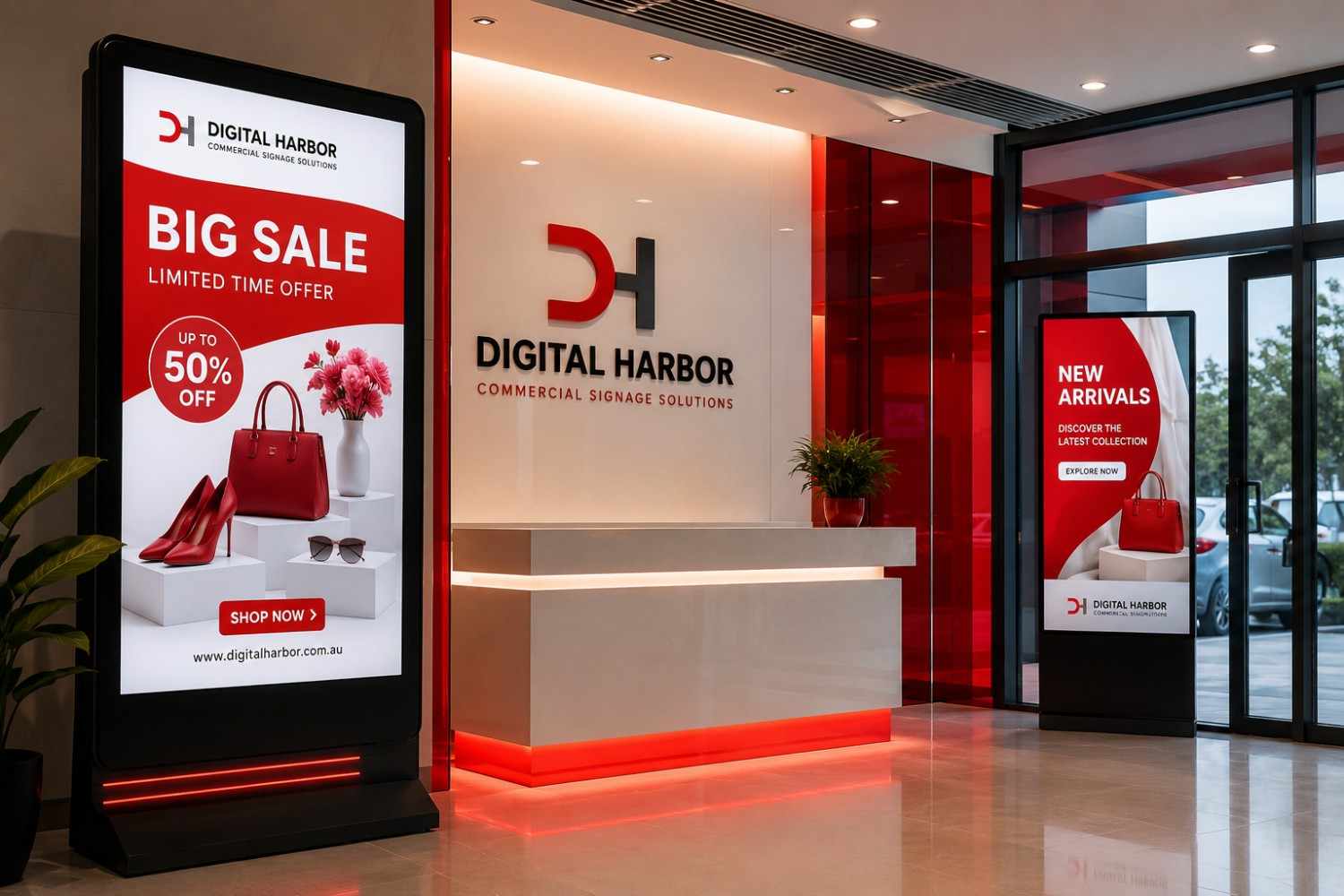
This guide breaks down everything you need to know about digital signage displays. How they work, what types exist, where businesses are using them right now, and what to actually look for before you invest. No fluff. Just useful, practical information.
The Simple Truth About Digital Signage Displays
A digital signage display is a screen-based communication system that lets businesses show dynamic content to an audience. Think menus, promotions, wayfinding maps, brand videos, announcements, and real-time information. All on a screen. All updatable remotely without printing a single sheet of paper.
In my experience, most business owners underestimate how much their signage is silently shaping customer perception. Static printed signs feel dated fast. Digital displays, on the other hand, keep things current, vivid, and engaging around the clock.
According to a Nielsen study, digital signage displays can increase brand awareness by up to 47.7%. That is not a minor bump. That is nearly half of your audience walking away with a stronger impression of your brand simply because of how you communicated with them.
Types of Digital Signage Displays You Should Know About
Not all digital signage is the same. The type you choose should match your space, your audience, and what you are trying to achieve. Here is a breakdown of the most common formats.
Window Digital Displays
These are high-brightness screens placed directly in shop windows. Because natural daylight can wash out regular screens, window displays are engineered to be visible even in direct sunlight.
I have noticed that retail stores using window displays see significantly higher foot traffic because the screen essentially acts as a 24/7 salesperson. Even when the shop is closed, the screen is still showing your latest offers to anyone walking by.
Digital Menu Boards
Restaurants, cafes, and food courts have been quick to adopt this one. A digital menu board replaces your static printed menu with a dynamic screen that you can update instantly. Running a lunch special? Add it in minutes. Sold out of something? Remove it without reprinting your entire menu.
For any food and beverage business, this is genuinely one of the smartest operational upgrades available.
Interactive Digital Displays
Touch-enabled screens that let users interact directly with the content. You see these in hotel lobbies, retail flagship stores, and real estate showrooms. The interaction builds engagement, and engagement builds memory.
When I tried interactive signage at a product showcase for the first time, the response from visitors was immediate. People would cluster around the screen, explore on their own, and spend far more time engaging with the brand than they would have with a brochure or a static banner.
Video Wall Displays
Multiple screens tiled together to form one large, seamless display. Video walls are powerful in high-footfall areas where you want visual impact. Airports, corporate reception areas, entertainment venues. They command attention in a way a single screen simply cannot.
Portable Outdoor Displays
Lightweight and weatherproof, these are designed for outdoor environments like drive-throughs, street-level retail, and events. They are increasingly popular with businesses that want flexibility without permanent installation.
Custom LED Displays
For spaces with non-standard dimensions or specific visual requirements, custom LED panels offer tailored solutions. Whether it is a uniquely shaped wall, an unusual ceiling installation, or a branded architectural feature, custom LED signage bridges the gap between aesthetics and function.
Where Businesses Are Actually Using Digital Signage Displays
Digital signage is not limited to one industry. The versatility is genuinely one of its strongest qualities. Here is where it is making a real difference right now:
- Retail stores use it to push promotions, highlight new arrivals, and reduce perceived wait time at checkout queues
- Restaurants and cafes use digital menu boards to upsell, update specials in real time, and enhance the dining atmosphere
- Corporate offices use lobby displays and internal communication screens to keep employees aligned and informed
- Healthcare facilities use wayfinding signage and patient information screens to reduce anxiety and improve navigation
- Hotels and hospitality venues use interactive displays for concierge services, event schedules, and local information
- Gyms and fitness centres use motivational displays and class schedule screens to energise their space
The common thread? In every one of these environments, static communication was replaced with something alive, dynamic, and useful.
What Makes a Good Digital Signage Display System
Choosing a screen is only part of the decision. A complete digital signage display system includes hardware, software, content management, and ongoing support. Here is what actually matters when you are evaluating your options.
Brightness and Visibility
A screen that looks great indoors might be completely invisible in a sunlit window. Always check brightness ratings, measured in nits, and match them to your environment. Outdoor and window-facing screens typically need 2500 nits or higher.
Content Management Software
This is the brain behind your display. Good software lets you schedule content, update it remotely from your phone or laptop, and manage multiple screens across different locations from a single dashboard.
Teams at Digital Harbor, for example, have built their systems with mobile app control at the centre, meaning clients can update their displays from anywhere without needing technical knowledge.
Build Quality and Reliability
Commercial displays are designed to run for extended hours, sometimes 18 to 24 hours a day, seven days a week. Consumer-grade screens are not built for this. Always use commercial-grade hardware for any business installation.
Installation and Ongoing Support
A beautiful display installed poorly is a liability. Cabling, mounting, ventilation, and connectivity all need professional attention. And once it is up, you want a support team you can actually reach if something goes wrong.
Benefits of Digital Signage Displays At a Glance
If you are still weighing whether it is worth it, here is an honest summary of the core benefits:
Flexibility. You can change your content in minutes. No design agency. No print run. No installation crew. Just log in and update.
Engagement. Moving visuals naturally capture attention more effectively than static images. Humans are wired to notice motion and light.
Brand consistency. Every screen across every location shows exactly what you want, exactly how you want it, at the exact time you choose.
Reduced long-term costs. Yes, there is an upfront investment. But when you stop reprinting menus, posters, and promotional materials every season, the savings become real quite quickly.
Real-time communication. Emergency announcement? Flash sale starting in an hour? Policy update? Push it to every screen in seconds.
Common Mistakes Businesses Make With Digital Signage
This part tends to get skipped in most guides, but it is genuinely worth reading.
Too much content on screen at once. A cluttered screen is worse than no screen. Keep messages short, bold, and readable from a distance.
Ignoring content refresh cycles. A digital display showing the same content for six months is not dynamic. It is just an expensive static sign. Build a content calendar and treat your signage like a marketing channel.
Choosing the wrong screen for the environment. Consumer TVs mounted in a window. Screens with no weatherproofing placed outdoors. These are mistakes that end up costing more to fix than doing it right the first time.
Skipping professional installation. I have seen business owners attempt DIY mounting to save money, and in several cases, the screens were poorly ventilated or mounted at angles that made them almost unreadable. Get it installed properly.
Why Businesses Choose Digital Harbor for Their Signage Needs
Digital Harbor has built a reputation in Australia for delivering end-to-end digital signage display solutions that are designed around how real businesses operate. From the initial consultation to installation and long-term management, the process is handled with precision.
What sets a good signage partner apart is not just the hardware. It is the understanding of your space, your customers, and what you are trying to communicate. Digital Harbor approaches each project with that lens, which is why their installations span retail, hospitality, healthcare, and corporate environments across Sydney, Melbourne, Brisbane, Perth, and Adelaide.
Digital Harbor delivers premium digital signage display solutions across Australia, serving businesses in Sydney, Melbourne, Brisbane, Perth, Adelaide, and beyond. Get in touch to explore the right solution for your space.