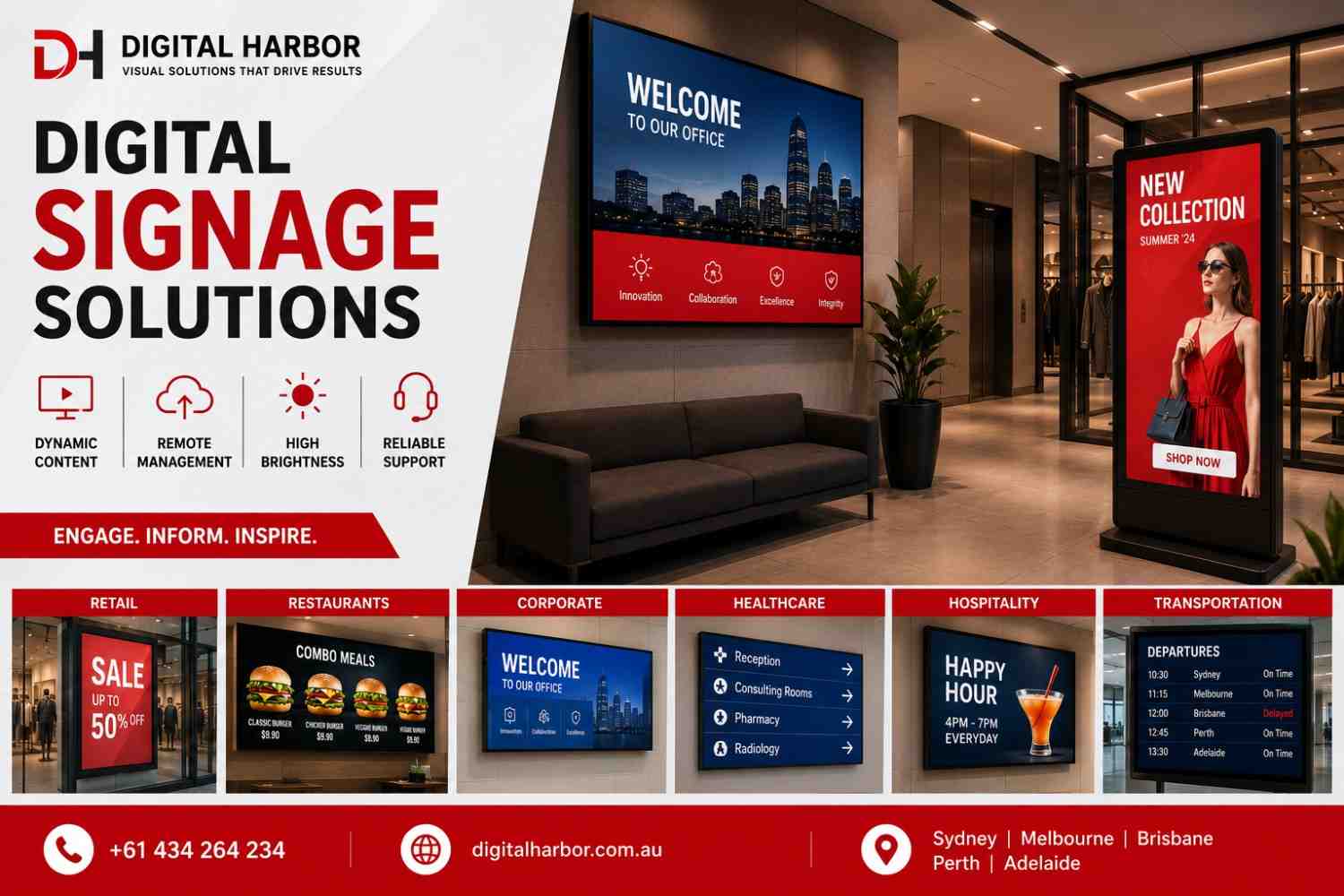
Your physical space is speaking to your customers right now. The question is whether it is saying something useful. Digital signage solutions give businesses the ability to turn walls, windows, counters, and reception areas into active communication channels that work around the clock without any manual effort.
This guide breaks it all down. What digital signage solutions actually are, how the different types work, which industries are getting the most out of them, and what you genuinely need to think about before making a decision. No sales pitch. Just practical, experience-based guidance.
What Digital Signage Solutions Actually Mean
The term gets used broadly, so it is worth being precise. A digital signage solution is not just a screen on a wall. It is a complete system that includes the display hardware, the software platform used to manage content, the network infrastructure that connects it all, and the installation and support structure that keeps it running.
When people say they want digital signage solutions, they usually mean they want the whole package to work seamlessly. That is a reasonable expectation, and it is the standard any serious provider should be held to.
Think of it like a restaurant kitchen. You could buy the best individual appliances on the market, but if they are not set up to work together, the service falls apart. Digital signage works the same way. Hardware and software need to be matched to each other and to the environment they are operating in.
Why Businesses Are Investing in Digital Signage Solutions Right Now
The shift away from printed and static signage has been building for years, but the pace has accelerated significantly as the hardware has become more accessible and the software more intuitive.
A study published by Invidis Consulting found that businesses using dynamic digital signage solutions reported up to a 40% increase in customer dwell time compared to environments using static displays. More time spent engaging with your space means more opportunities to communicate, to upsell, and to leave a lasting impression.
In my experience, the businesses that see the strongest return from digital signage are not necessarily the ones with the biggest budgets. They are the ones that are clearest about what they want to communicate and to whom. A small cafe with a single well-placed digital menu board updated twice a day consistently outperforms a large retailer running the same generic content loop for months.
The Core Components of Any Digital Signage Solution
Before you evaluate options, it helps to understand what you are actually buying. Every digital signage solution involves these core elements.
Display Hardware
This is the screen itself. Commercial-grade displays are built differently from consumer televisions. They are designed to run for extended hours, sometimes 24 hours a day, seven days a week, without the reliability issues that a consumer TV would develop under the same conditions. Display hardware choices include flat panels, LED tiles, video walls, window-facing high-brightness screens, outdoor weatherproof units, and interactive touchscreens.
Content Management Software
This is the brain of your digital signage solution. It is the platform through which you create, schedule, and push content to your screens. Good content management software lets you manage multiple screens across multiple locations from a single dashboard, set schedules for different content at different times of day, and make real-time updates from your phone or laptop without touching the physical screen.
Media Players and Connectivity
The media player is the device that actually drives the content on your display. Some screens have built-in media players. Others require an external device. Either way, reliable network connectivity, whether through Wi-Fi or a wired ethernet connection, is essential for remote content management and real-time updates.
Installation and Mounting
A display installed poorly is a liability. Incorrect mounting, poor cabling management, inadequate ventilation, and misaligned viewing angles all affect both the performance and the longevity of the installation. Professional installation is not optional if you want your digital signage solution to perform the way it should.
Ongoing Support
Screens have occasional technical issues. Content needs refreshing. Software gets updated. Any digital signage solution worth investing in should come with a support structure that gives you somewhere to turn when something needs attention.
The Main Types of Digital Signage Solutions
Different environments call for different approaches. Here is a practical overview of the most common types of digital signage solutions and where each one fits best.
Indoor Digital Signage
The most widely used category. Indoor solutions span digital menu boards, reception area displays, retail floor screens, corridor wayfinding panels, and meeting room information displays. Because they operate in controlled environments, indoor screens can be specified for lower brightness and without weatherproofing, which gives more flexibility in terms of size and form factor.
When I tried an indoor digital signage solution in a corporate office lobby, the impact on visitor experience was immediate and measurable. Visitors commented on it. Staff found it easier to share company news and event information without relying on email chains or notice boards.
Outdoor Digital Signage
Outdoor solutions require higher brightness panels, weatherproof enclosures rated to at least IP65, and thermal management for heat and humidity. These are non-negotiable specifications, not optional extras. Skipping any of them creates operational problems that cost more to fix than doing it right the first time.
Interactive Digital Signage
Touchscreen-enabled displays that allow customers or visitors to interact directly with content. These are particularly effective in retail environments where product exploration matters, in real estate showrooms where browsing a full property listing on a large screen beats scrolling a phone, and in hospitality venues where self-service information adds genuine value.
Video Wall Solutions
Multiple panels tiled together to form a single large display surface. Video walls create visual impact that individual screens cannot match. They are used in flagship retail environments, corporate headquarters, broadcast studios, and entertainment venues where scale and visual drama serve a clear purpose.
Digital Menu Board Solutions
A specific category worth calling out because of how widely relevant it is. Any business that serves food or beverages, from a single-location cafe to a multi-site franchise, benefits from the flexibility and visual quality that a digital menu board delivers over a printed alternative. Real-time updates, daypart scheduling, promotional content, and food imagery all combine to make menus more effective.
Custom LED Display Solutions
For spaces where standard screen sizes do not fit, custom LED panel solutions allow precise dimensional specification. These are used in architectural installations, unusual wall configurations, and large-format branded environments where the display itself is part of the design intent.
Industries Getting the Most From Digital Signage Solutions
Digital signage solutions are not sector-specific, but some industries have adopted them more comprehensively than others, and the results speak for themselves.
Retail is the most active adopter. Promotional content, product highlights, brand storytelling, and queue management are all being handled through digital signage in stores of every size.
Food and beverage businesses use digital menu boards and promotional screens to upsell, manage daypart transitions, and create a more polished customer environment without the cost and delay of reprinting every time something changes.
Healthcare facilities use digital signage solutions for wayfinding, patient information, appointment management, and health awareness communication across waiting areas and corridors.
Corporate offices use lobby displays, meeting room panels, and internal communication screens to keep employees informed and give visitors a professional first impression.
Education providers use campus digital signage for event promotion, emergency notifications, campus maps, and daily schedule information accessible from high-traffic common areas.
I have noticed that in healthcare environments particularly, well-implemented digital signage solutions significantly reduce the anxiety that comes from uncertainty. A screen in a waiting room that shows estimated wait times and relevant information keeps patients calmer and more informed without any additional staff effort.
What to Look for When Choosing a Digital Signage Solutions Provider
This is where most guides stop short. Choosing the hardware is only part of the decision. Choosing the right partner matters just as much.
Here are the things that actually differentiate good digital signage solutions providers from average ones:
They ask questions before recommending anything. A provider who jumps straight to a hardware recommendation without understanding your space, your audience, your content goals, and your operational capacity is not giving you a considered solution.
They offer end-to-end service. Consultation, hardware supply, software setup, professional installation, training, and ongoing support should all be available from the same team. Fragmented responsibility means fragmented accountability.
They have real installation experience across different environments. Retail is different from healthcare is different from hospitality is different from corporate. A provider who has worked across multiple sectors will give you better advice than one with a narrow track record.
They are transparent about what the system can and cannot do. No digital signage solution is perfect for every situation. A provider who tells you honestly when something is not the right fit for your needs is more trustworthy than one who promises everything.
Digital Harbor approaches every project this way. Before any hardware is specified, the team works through the environment, the use case, and the content strategy with the client. That process shapes the recommendation, not the other way around.
How Digital Harbor Delivers Digital Signage Solutions Across Australia
Digital Harbor serves businesses across Sydney, Melbourne, Brisbane, Perth, and Adelaide with a full-service approach to digital signage solutions. From initial consultation through to installation and ongoing management support, the team works with clients to build systems that are matched to their actual needs rather than off-the-shelf specifications.
In my experience working with businesses that have gone through proper consultative digital signage processes, the outcomes are consistently stronger than those achieved by businesses that simply purchased screens and figured out the rest as they went. The difference is not the hardware. It is the thinking behind the installation.
Whether you are a single-site small business or a multi-location operation, the principles are the same. Understand what you want to say, to whom, and in what context. Then build the solution around that clarity.
Digital Harbor provides digital signage solutions for businesses of all sizes across Sydney, Melbourne, Brisbane, Perth, Adelaide, and surrounding regions. Reach out to discuss what a properly designed digital signage solution looks like for your space.