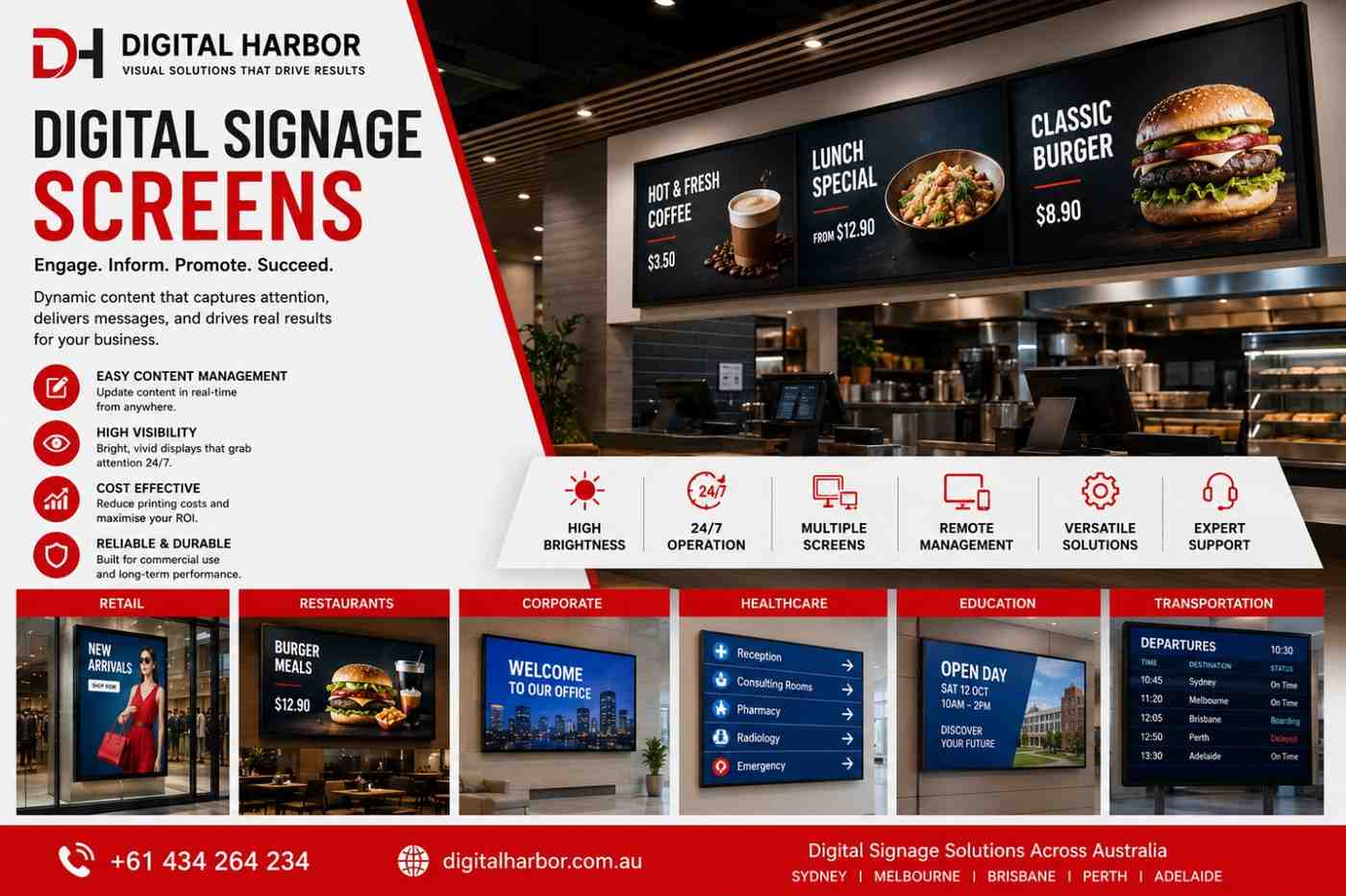
Businesses across Australia are making the shift from static printed signs to dynamic digital displays. Whether you run a restaurant in Sydney, a retail boutique in Melbourne, or a corporate office in Brisbane, digital signage is no longer a luxury. It's fast becoming a baseline expectation.
This guide breaks down everything, from what digital signage screens actually are, to how you choose the right one, to what makes a deployment genuinely successful.
What Are Digital Signage Screens?
At the most basic level, digital signage screens are electronic displays used to show content images, videos, menus, announcements, promotions in a public or semi-public space. But that definition undersells them.
Think of them less like "screens" and more like always-on communication channels. You control what plays, when it plays, and to whom. You can update content in real time, schedule promotions hours in advance, or tailor messaging to the time of day. A breakfast café special at 8am. A lunch deal at noon. A happy hour promo at 4pm. All automated. All effortless.
In my experience, the businesses that get the most out of digital signage aren't the ones with the biggest screens. They're the ones who treat their displays as a strategic asset, not a decoration.
Why Businesses Are Switching to Digital Displays
Static signage has served businesses well for a long time. But it has a few painful limitations you've probably already noticed.
Printing takes time. Updating content costs money. And a printed poster in a window feels, well, a little dated when the business next door has a vivid LED display cycling through their latest offers.
Digital signage screens solve all of that.
According to a study by Nielsen, digital signage reaches more than 135 million viewers per week across the US alone, and similar growth patterns are playing out across Australia. Locally, businesses in high-footfall areas like shopping centres, airports, and high streets are investing in digital displays because the return on visibility is tangible.
Here's what the shift actually gives you:
- Real-time content updates from anywhere, using a mobile app or browser
- Higher engagement rates compared to static print (visual motion naturally draws the eye)
- Reduced long-term costs by eliminating recurring print expenses
- Brand consistency across multiple locations from a single dashboard
- Flexibility to run different content for different times, audiences, or promotions
The last point matters more than people realise. A printed menu can't know it's Friday night. A digital menu board can.
Types of Digital Signage Screens
Not all digital signage is the same. The right screen depends on your environment, your audience, and what you're trying to communicate.
Indoor Digital Signage
This is the most common starting point for most businesses. Indoor screens are optimised for controlled lighting environments and typically offer excellent resolution and colour accuracy.
Digital menu boards are probably the most recognisable example. Walk into any modern café or fast food outlet and you'll see them. They replace printed menu boards with bright, dynamic displays that can be updated instantly. When I first helped a café owner switch to digital menus, they told me the biggest surprise wasn't how good it looked, it was how much time they saved every time they changed a price or added a seasonal item.
Window digital displays are another indoor category worth knowing about. These face outward through shopfront glass. Ultra-bright panels (often 2,500–5,000 nits of brightness) ensure your content is visible even in direct sunlight. For retail stores, these essentially turn your window into a 24-hour salesperson.
Interactive digital displays add a touchscreen layer, allowing customers to browse products, check in, explore menus, or engage with branded content. Hotels, showrooms, and hospitals are increasingly using these to reduce staff workload while improving the customer experience.
Video walls are large-format displays made up of multiple panels tiled together. They're dramatic, immersive, and incredibly effective in high-traffic environments like shopping centres, exhibition halls, and corporate lobbies.
Outdoor Digital Signage
Outdoor screens are built to handle weather, temperature variation, and much higher ambient light levels. They're also typically housed in protective enclosures rated for dust and moisture resistance.
Portable outdoor displays are a smart choice for businesses like drive-throughs, food trucks, outdoor markets, or any setting where the screen location might need to change. They offer the flexibility of digital content without the permanence of a fixed installation.
Custom LED Displays
For spaces with unusual dimensions or architectural constraints, custom-sized LED panels are the answer. Rather than forcing a standard screen into an awkward space, you get a display engineered to fit your exact requirements.
The team at Digital Harbor specialises in this, offering custom LED display solutions in specific standard sizes like 1920 × 640mm and 960 × 640mm, as well as fully bespoke dimensions for one-of-a-kind installations.
How to Choose the Right Digital Signage Screen
This is where most people get stuck. There are a lot of screens out there. Here's how to cut through the noise.
1. Start With Your Environment
Is the screen going indoors or outdoors? What's the ambient light like? A screen that looks stunning in a dim indoor setting can wash out completely near a sunlit window. Brightness (measured in nits) is one of the most overlooked specs when people are shopping for signage.
2. Consider Viewing Distance
A massive LED wall makes perfect sense in a 500-seat auditorium. A 55-inch commercial display is far more appropriate for a café counter. The pixel pitch (the distance between LED dots) determines how close a viewer can stand before individual pixels become visible. Closer viewing distances need a finer pixel pitch.
3. Think About Content Management
A screen without a reliable content management system (CMS) is just a TV. You want a platform that lets you schedule content, push updates remotely, and manage multiple screens from one place. In my experience, this is where the real value lives. Hardware is hardware, but smart software is what makes your investment work hard every day.
4. Plan for Longevity
Commercial-grade digital signage screens are built differently to consumer TVs. They're designed to run for 16–18 hours a day, often 7 days a week. When you're buying signage for a business, commercial-grade hardware isn't optional, it's essential.
Common Mistakes to Avoid
I've seen businesses invest well in screens and then undercut themselves in execution. Here are the most common missteps:
- Using consumer televisions instead of commercial displays. Consumer TVs are not built for the duty cycles required in business settings. They fail faster and often void their warranties if used for commercial purposes.
- Ignoring content strategy. A beautiful screen showing poorly designed content is still a missed opportunity. Your visuals need to be compelling, on-brand, and easy to read at a glance.
- Overcomplicating the message. People passing a window display have about 3 seconds to absorb your message. One clear offer beats six cluttered ones every time.
- Skipping professional installation. Mounting, cabling, and network connectivity all affect performance and longevity. A poor install can shorten the life of your hardware significantly.
Industries Using Digital Signage Screens in Australia
Hospitality and food service are the most obvious adopters, with digital menu boards now standard in most fast casual and quick service restaurants. But the reach goes much further.
Retail uses window displays and in-store screens to drive impulse purchases and promote time-sensitive offers. Fashion stores in particular benefit from the ability to match their in-store displays to seasonal campaigns instantly.
Healthcare facilities use digital screens to manage patient flow, display appointment information, and reduce perceived wait times in reception areas.
Corporate environments deploy screens for internal communications, visitor wayfinding, and meeting room signage. A well-placed display in a lobby communicates professionalism before a word is spoken.
Education uses digital signage for campus wayfinding, event announcements, and dynamic timetabling.
Providers like Digital Harbor serve clients across all these sectors, working with businesses in Sydney, Melbourne, Brisbane, Perth, and beyond to deliver installations that are tailored to the specific demands of each industry.
Getting Started: What the Process Actually Looks Like
If you're considering digital signage for your business, here's a realistic overview of what a good implementation process looks like:
- Discovery and consultation — Understanding your business goals, space, audience, and budget
- Hardware and software planning — Matching the right screen type, size, and CMS to your needs
- Content design — Creating templates and assets that work for your brand and viewing context
- Installation — Professional mounting, cabling, and network setup
- Training and handover — Ensuring you and your team can manage content confidently
- Ongoing support — Updates, troubleshooting, and scaling as your needs grow
That fifth step is one I always emphasise. The best signage partnerships are the ones where the client feels genuinely empowered to update their own content without needing to call someone every time.