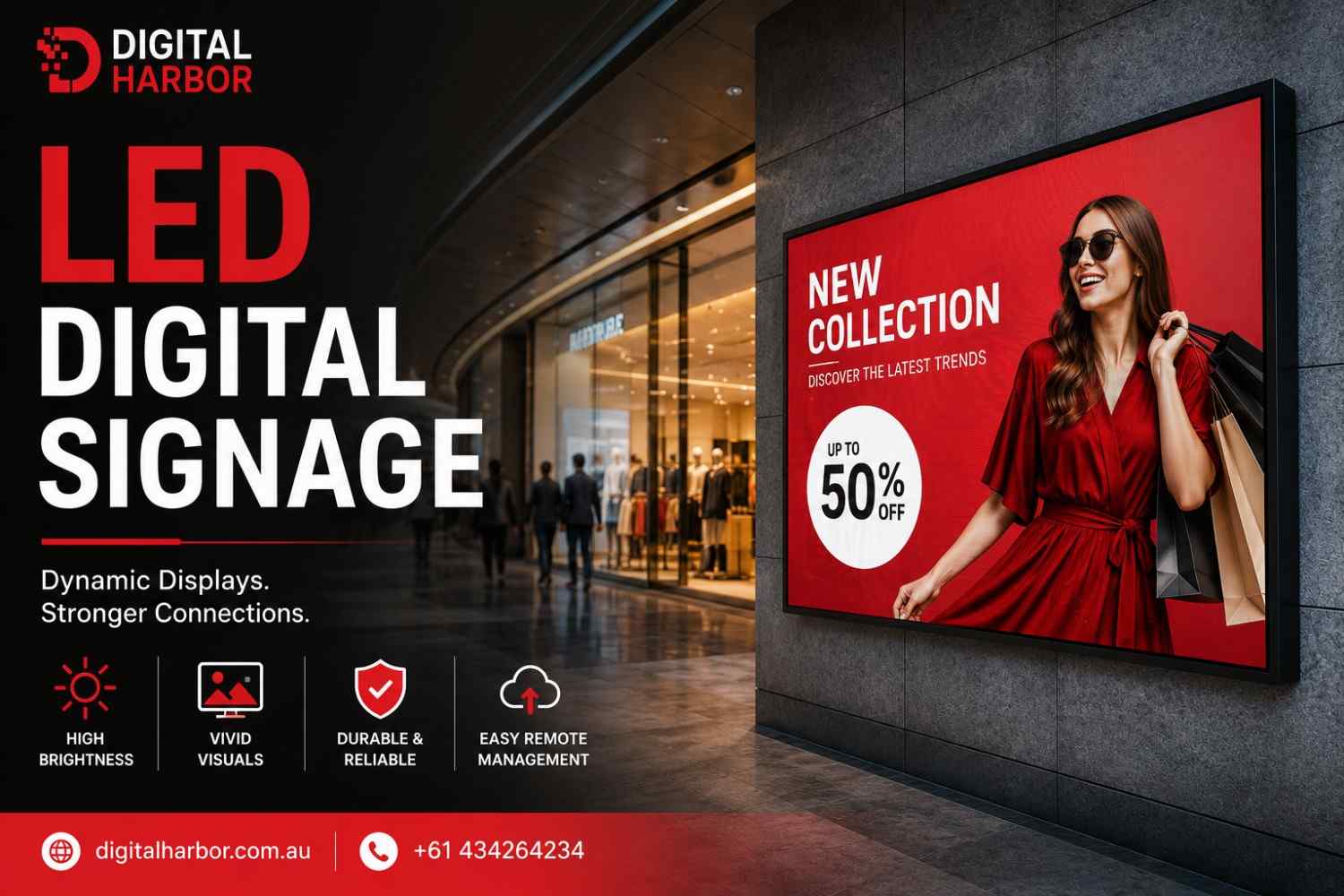
Static signage does one thing. It sits there. LED digital signage does something entirely different. It moves, adapts, updates in real time, and commands attention in a way that printed alternatives simply cannot compete with. If your business communicates with customers through a physical space, this technology deserves your serious attention.
This guide is written for business owners, operations managers, and anyone responsible for how a commercial space looks and communicates. Not for engineers. Not for AV specialists. Just practical, honest information about what LED digital signage is, how it works, what to look for, and how to avoid the decisions that lead to disappointing results.
What LED Digital Signage Actually Means
The term combines two distinct ideas. LED refers to the display technology, Light Emitting Diode panels that produce bright, vivid, energy-efficient visuals. Digital signage refers to the system of managing and delivering content to screens in a commercial environment. Together, LED digital signage describes a complete system where LED hardware and digital content management work as one.
It is worth being clear about this because some businesses buy the hardware without thinking through the content management side, and then find themselves with an expensive screen showing the same static image for months. The display and the software behind it are equally important parts of what makes LED digital signage genuinely useful.
Think of it like a commercial kitchen. The equipment matters enormously. But without a menu, a plan, and someone updating the specials board, the kitchen is not doing its job. LED digital signage works the same way. Hardware and content strategy need to be considered together from the start.
Why LED Digital Signage Has Become the Standard for Commercial Spaces
The shift from printed and static signage to LED digital signage across Australian commercial environments has been accelerating for good reason. The performance gap between the two is significant and measurable.
A study by Arbitron found that nearly 70% of people recalled seeing a digital sign in the past month, compared to significantly lower recall rates for static alternatives. More importantly for businesses, dynamic content consistently drives higher engagement and purchase intent than static messaging in the same location.
In my experience, the businesses that see the strongest results from LED digital signage are those that treat it as an active communication channel rather than a decorative installation. The businesses that update their content regularly, align it with their current promotions and seasonal activity, and think carefully about what their audience needs to see at different times of day consistently outperform those running generic loops with no clear strategy behind them.
The other driver of adoption is operational efficiency. Every time a business updates its printed signage, there is a cost. Design fees, printing fees, installation time, and disposal of outdated materials all add up over a year. LED digital signage eliminates most of those costs. An update that previously took days and cost hundreds of dollars happens in minutes from a phone or laptop at no additional cost per change.
The Core Components of an LED Digital Signage System
Before you evaluate any LED digital signage solution, understanding what you are actually buying helps you ask better questions and make better decisions.
The Display Hardware
This is the LED panel or panels that produce the visible image. Commercial LED display hardware is manufactured in a wide range of sizes, pixel pitches, brightness ratings, and environmental specifications. The display hardware you choose needs to match your installation environment, your viewing distance, your ambient light conditions, and your operational hours. Getting these specifications right is the foundation of a successful LED digital signage installation.
The Media Player
The media player is the device that drives content to the display. Some LED panels have integrated media players built into the unit. Others require an external player connected via HDMI or a proprietary interface. The media player handles content decoding, playback scheduling, and communication with the content management platform.
The Content Management Software
This is the platform through which you create, organise, schedule, and push content to your LED digital signage displays. Good content management software is intuitive enough for non-technical users to operate confidently, flexible enough to support multi-screen management across multiple locations, and robust enough to handle scheduled content changes, real-time updates, and remote monitoring from any internet-connected device.
The Network Infrastructure
LED digital signage systems rely on network connectivity to deliver remote content management, real-time updates, and system monitoring. Whether your installation uses Wi-Fi or a wired ethernet connection, a reliable and appropriately specified network connection is essential for the system to function as intended.
Professional Installation and Ongoing Support
The hardware and software are only as good as the installation behind them. Incorrect mounting, inadequate ventilation, poorly managed cabling, and misaligned viewing angles all affect performance and longevity. Professional installation by experienced technicians, combined with access to ongoing technical support, is part of what makes an LED digital signage investment deliver value over the long term.
Key Technical Specifications You Need to Understand
These are the numbers that actually determine whether an LED digital signage system performs in your specific environment.
Pixel Pitch
The distance in millimetres between adjacent LED clusters on a panel. Smaller pixel pitch means higher resolution and sharper imagery at closer viewing distances. For a counter-facing indoor display viewed from one to two metres, a pixel pitch of P1.5 to P2.5 is appropriate. For a large outdoor display viewed from eight metres or more, P6 to P10 delivers adequate resolution at a more practical specification level.
Matching pixel pitch to your intended viewing distance is one of the most consequential specification decisions you will make for any LED digital signage installation.
Brightness
Measured in nits. Indoor LED digital signage typically operates at 800 to 1500 nits. Window-facing displays need a minimum of 2500 nits to compete with incoming daylight. Outdoor installations in Australian conditions, where UV intensity is particularly high, require 5000 nits or above for reliable daytime visibility.
When I tried specifying an outdoor LED digital signage installation at a lower brightness rating to reduce costs for a client, the result was a screen that performed acceptably in the morning and was almost invisible during peak afternoon hours. We replaced the panels within the first month. Specifying brightness correctly at the outset costs less than getting it wrong.
Refresh Rate
The number of times per second the display redraws its image, measured in Hertz. For LED digital signage in environments where the displays are frequently photographed or filmed, a refresh rate of 3840Hz or above eliminates the banding and flicker effects that appear at lower refresh rates when captured on camera. For hospitality venues, retail environments, and any business with a strong social media presence, this specification matters more than it might initially seem.
Contrast Ratio
The ratio between the brightest and darkest values a display can produce simultaneously. Higher contrast means more vivid, lifelike imagery with deeper blacks and more saturated colours. For LED digital signage used to display food photography, product imagery, or brand video content, contrast ratio directly affects the visual quality of the result.
IP Rating
For any LED digital signage installation in an outdoor or semi-outdoor environment, the IP rating specifies the level of protection against dust and moisture ingress. IP65 is the minimum appropriate rating for outdoor installations. Coastal locations or environments with high humidity or frequent heavy rain should be specified at IP66 or higher.
The Different Types of LED Digital Signage
LED digital signage is not a single product. It is a category that spans a wide range of formats, each suited to different environments and communication objectives.
Indoor LED Digital Signage
The most widely installed category. Indoor LED digital signage covers retail promotional screens, digital menu boards, corporate reception displays, wayfinding panels, meeting room information screens, and in-store brand communication displays. Indoor environments allow more flexibility in brightness specification and form factor because the displays do not face the same environmental demands as outdoor installations.
I have noticed that indoor LED digital signage in retail environments consistently outperforms the LCD screens it replaces in terms of customer engagement. The colour depth, the contrast, and the brightness of LED panels in a retail setting creates a visual quality that draws attention in a way that lower-specification alternatives do not.
Outdoor LED Digital Signage
Engineered for external environments. Outdoor LED digital signage must handle direct sunlight, rain, dust, temperature extremes, and in coastal locations, salt air. The specification requirements for Australian outdoor installations are particularly demanding given the UV intensity and heat loads involved. High-brightness panels, robust weatherproof enclosures, and effective thermal management are all non-negotiable for outdoor LED digital signage in this market.
Window-Facing LED Digital Signage
High-brightness LED digital signage panels installed inside a building but positioned against a window to face outward. This format captures pedestrian attention without requiring external weatherproofing, making it a practical and highly effective solution for retail strips, shopping centre tenancies, and any business with a prominent window frontage.
LED Digital Video Walls
Multiple LED panels tiled together to form a single large seamless display surface. LED digital video walls are used in flagship retail stores, corporate headquarters, conference and exhibition centres, hospitality venues, and any environment where visual scale and impact are central to the communication objective.
The ability to create a display of any size without visible seams between panels is one of the defining advantages of LED tile technology over LCD video wall alternatives, which always carry visible bezels between screens regardless of how narrow those bezels are.
LED Digital Menu Boards
A purpose-built application of LED digital signage technology for the food and beverage sector. LED digital menu boards combine high visual quality with content management systems designed specifically for menu environments. Daypart scheduling, real-time item management, promotional content integration, and high-quality food imagery all combine to create a menu presentation that is measurably more effective than its printed equivalent.
Custom LED Digital Signage
For spaces where standard panel dimensions or configurations do not fit the environment or the design intent, custom LED digital signage solutions allow precise specification of size, shape, curvature, and layout. Architecturally integrated displays, curved installations, non-standard aspect ratios, and branded environmental features are all achievable through custom LED digital signage design.
Digital Harbor has delivered custom LED digital signage installations across a range of Australian commercial environments where off-the-shelf solutions were not appropriate for the space. The design flexibility of LED technology makes it uniquely suited to bespoke commercial applications.
Industries Across Australia Using LED Digital Signage Effectively
The adoption of LED digital signage across Australian industries reflects the genuine breadth of its practical applications.
Retail businesses use LED digital signage for promotional content, seasonal campaigns, product spotlighting, and brand storytelling across store formats of every size. The ability to align in-store signage with online campaign activity in real time is a significant operational advantage for retail businesses running integrated marketing programs.
Food and beverage businesses across Australia have adopted LED digital menu boards and promotional screens as standard elements of their fit-out. The flexibility to update content across multiple locations from a single platform makes LED digital signage particularly valuable for multi-site operators managing consistent brand presentation across different cities.
Healthcare facilities use LED digital signage for patient wayfinding, appointment and queue management, health awareness content, and waiting room communication. In clinical environments, the clarity and brightness of LED displays improves information accessibility for patients across all age groups and literacy levels.
Corporate offices use LED digital signage in reception areas, collaboration spaces, and meeting rooms for branding, visitor information, internal communications, and real-time data displays. A polished LED digital signage installation in a corporate environment communicates the quality and professionalism of the organisation to everyone who enters.
Hospitality venues including hotels, bars, clubs, and entertainment facilities use LED digital signage for event promotion, wayfinding, menu presentation, atmosphere creation, and guest information. The visual quality of LED signage in a premium hospitality environment contributes directly to the perceived quality of the overall experience.
Education providers use LED digital signage across campuses for event promotion, schedule information, emergency notifications, and community engagement content. The remote management capability of cloud-based LED digital signage platforms makes it practical to maintain consistent, current content across large campuses with many screens and minimal dedicated staff resources.
Common Mistakes to Avoid With LED Digital Signage
These are the decisions that consistently lead to underperforming installations and frustrated business owners.
Underspecifying brightness for the environment. A display that looks vivid in a showroom at 1000 nits can be effectively invisible in a sunlit window or outdoor location. Always specify brightness for the actual ambient light conditions of the installation environment, not for showroom conditions.
Treating content as an afterthought. The display is infrastructure. The content is the communication. Businesses that install LED digital signage without a content plan and a refresh schedule end up with an expensive screen showing outdated or irrelevant information. Build a content strategy into the project from the beginning.
Choosing consumer-grade hardware for commercial applications. Consumer televisions are not designed for the operational hours, ambient conditions, or longevity requirements of commercial LED digital signage. Always specify commercial-grade hardware for any business installation.
Skipping professional installation. Incorrect mounting, inadequate ventilation, and poor cabling management create problems that cost more to fix than doing the installation correctly from the start. Professional installation by experienced technicians is part of the investment, not an optional extra.
Ignoring the content management platform. The software that manages your LED digital signage is as important as the hardware itself. A platform that is difficult to use will result in infrequent content updates, which means the display stops functioning as an active communication channel and starts functioning as an expensive static sign.
How Digital Harbor Delivers LED Digital Signage Across Australia
Digital Harbor works with businesses across Sydney, Melbourne, Brisbane, Perth, and Adelaide on LED digital signage projects that are built around the specific communication goals and operational requirements of each client.
The process at Digital Harbor starts with consultation before specification. That means understanding the environment, the audience, the content management capacity of the client team, and the long-term communication objectives of the business before any hardware recommendation is made. The recommendation follows the understanding, not the other way around.
Every LED digital signage installation delivered by Digital Harbor is supported by professional installation, content management platform setup and training, and ongoing technical support. The goal is a system that performs exactly as intended from day one and continues to deliver communication value as the business and its needs evolve.
Digital Harbor delivers LED digital signage solutions for businesses of all sizes across Sydney, Melbourne, Brisbane, Perth, Adelaide, and the broader Australian market. Reach out to the team to discuss what the right LED digital signage setup looks like for your space and your communication goals.