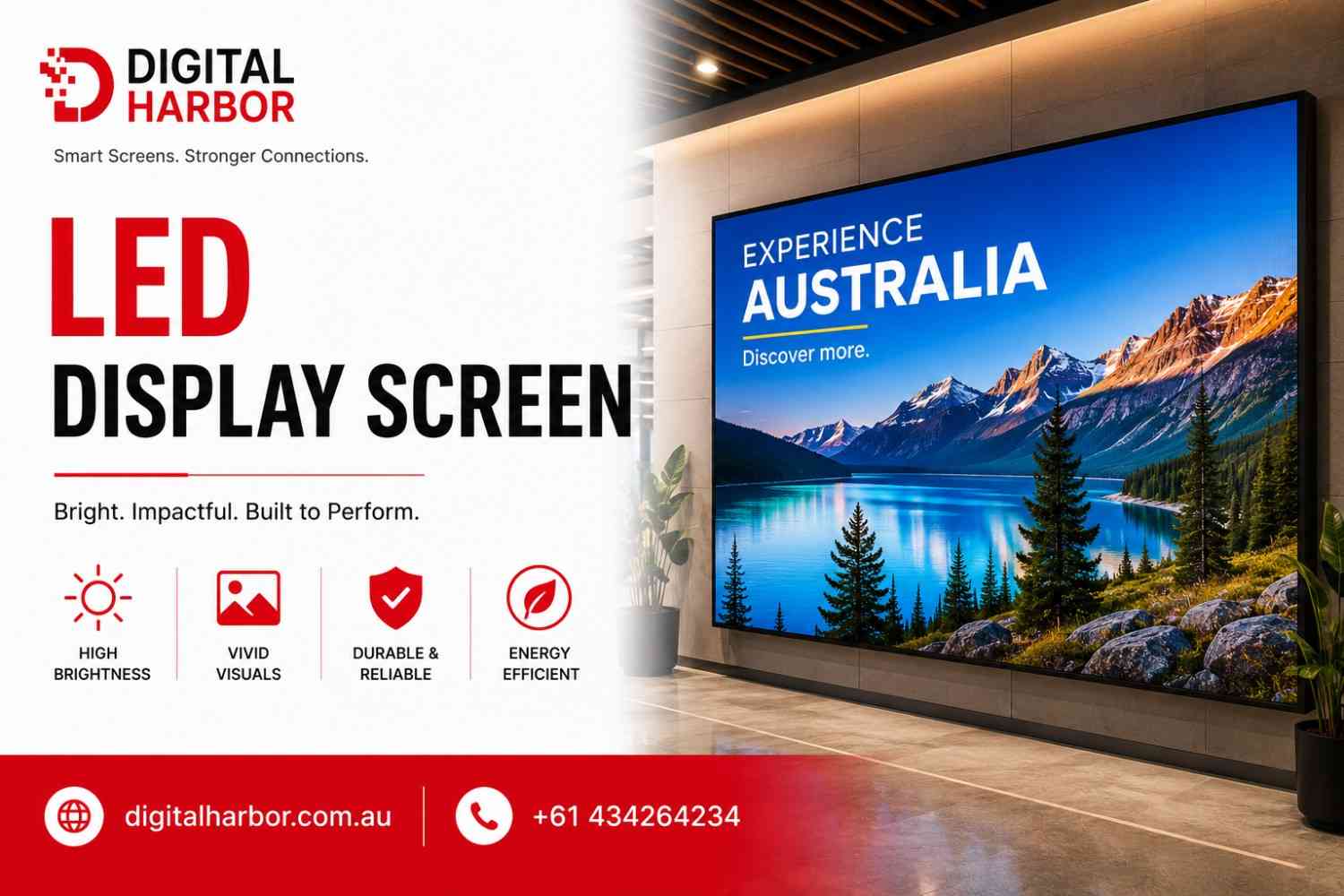
Walk into almost any successful retail store, restaurant, or corporate office in Australia right now and you will find one. An LED display screen has become the baseline expectation for businesses that want their physical spaces to work as hard as the rest of their marketing. The question is no longer whether you need one. It is which one is right for you and why.
This guide gives you the full picture. What LED display screens actually are, how the technology works, what separates a good installation from a poor one, which types suit which environments, and what you should genuinely be thinking about before you spend a cent. Practical, direct, and based on real experience across Australian commercial environments.
What an LED Display Screen Actually Is
LED stands for Light Emitting Diode. An LED display screen uses thousands or millions of these tiny light sources arranged in a grid to produce images, video, and text with exceptional brightness and colour accuracy.
Unlike older display technologies that used fluorescent backlighting or plasma cells, LED panels generate light directly at the pixel level. This gives them significant advantages in brightness, contrast, energy efficiency, and operational lifespan compared to the technologies they have largely replaced in commercial applications.
The result is a display that is vivid in virtually any lighting condition, robust enough for long operational hours, and flexible enough to be produced in almost any size or configuration. That combination is why LED display screens have become the dominant technology for commercial signage across Australia and globally.
Why LED Display Screens Outperform Every Alternative
This is worth being direct about. When businesses ask whether an LED display screen is the right choice for a commercial application, the honest answer in most cases is yes. The reasons are not marketing language. They are engineering realities.
Brightness is the first reason. LED display screens can achieve brightness levels that no other commercial display technology matches at scale. For outdoor applications in Australian conditions where UV intensity is among the highest in the world, this is not a preference. It is a requirement.
Lifespan is the second reason. Commercial LED panels are rated for 50,000 to 100,000 hours of operation. Running a screen for 12 hours a day, that translates to well over a decade of operational life before significant degradation occurs. No alternative display technology comes close to that figure in commercial use.
Energy efficiency is the third reason. LED display screens consume significantly less power per unit of brightness output than fluorescent or older LCD technologies. For businesses running displays for extended hours every day, the energy saving compounds meaningfully over time.
Flexibility is the fourth reason. LED panels can be manufactured in virtually any size, can be tiled into video walls of any dimension, can be curved or shaped to fit architectural requirements, and are available in configurations from fine-pitch indoor panels to large-format outdoor arrays. No other display technology offers that range.
According to a report by MarketsandMarkets, the global LED display market is projected to reach USD 30 billion by 2026, with commercial signage applications driving a significant portion of that growth. The trajectory reflects real adoption decisions being made by real businesses based on real performance outcomes.
Understanding LED Display Screen Specifications
Before you evaluate any LED display screen, you need to understand the specifications that actually determine performance. These are the numbers that matter.
Pixel Pitch
Pixel pitch is the distance in millimetres between the centres of adjacent LED clusters on a panel. A smaller pixel pitch means more LEDs per square metre, which means higher resolution and sharper image quality at closer viewing distances.
For a reception area display viewed from two to three metres away, a pixel pitch of P2 to P3 is appropriate. For a large outdoor display viewed from ten metres or more, a P6 to P10 pitch is sufficient and more cost-effective. Matching pixel pitch to your intended viewing distance is one of the most important specification decisions you will make.
Brightness
Measured in nits, brightness determines how visible your LED display screen is in different ambient light conditions. Indoor displays typically operate at 800 to 1500 nits. Window-facing displays need 2500 nits or above. Outdoor displays in direct Australian sunlight require 5000 nits or higher to maintain full visibility throughout the day.
In my experience, brightness is the specification most commonly underestimated by first-time buyers. A screen that looks impressive in a showroom at 1000 nits can appear almost invisible once it is positioned in a sunlit window. Get this specification right for your actual environment.
Refresh Rate
Measured in Hertz, refresh rate determines how smoothly motion is displayed and whether the screen produces visible flicker when captured on camera. For most commercial applications, a refresh rate of 3840Hz or above is recommended. This is particularly important for businesses in media-heavy environments, hospitality venues that are frequently photographed, or any location where customers are likely to capture content on their phones.
Contrast Ratio
Contrast ratio describes the difference between the brightest white and the darkest black a screen can produce simultaneously. A higher contrast ratio means more vivid colours and deeper blacks, which translates to more visually striking content. For retail and hospitality applications where food imagery and product photography are central to the content strategy, contrast ratio deserves attention.
IP Rating
For any LED display screen installed in an outdoor or semi-outdoor environment, the IP rating specifies how well the unit is sealed against dust and moisture. IP65 is the minimum acceptable rating for outdoor use. For coastal locations or environments with high humidity, IP66 or IP67 provides additional protection against more demanding moisture exposure.
Operating Temperature
Australian summers routinely push ambient temperatures above 40 degrees Celsius in many regions. Commercial LED display screens need to be rated for the operating temperature range of their installation environment, with thermal management systems that prevent overheating during peak heat periods.
The Different Types of LED Display Screens
LED display screen technology is applied across a wide range of formats and environments. Understanding the main types helps you identify which one fits your situation.
Indoor LED Display Screens
Designed for controlled interior environments. Indoor LED panels are typically specified with finer pixel pitches for closer viewing distances, lower brightness settings appropriate for ambient indoor lighting, and sleeker form factors that suit retail, corporate, and hospitality aesthetics.
Common indoor applications include retail promotional screens, digital menu boards, reception area displays, meeting room information panels, and corporate lobby video walls. The controlled environment means less demanding weatherproofing requirements, which opens up more flexibility in size, resolution, and mounting configuration.
When I tried an indoor fine-pitch LED display screen installation in a high-end retail environment in Sydney, the visual quality difference compared to the LCD screens it replaced was immediately apparent to both staff and customers. The colour depth, the blacks, and the overall presence of the display transformed the feel of the entire space.
Outdoor LED Display Screens
Built to operate in open or exposed environments. Outdoor LED display screens are specified with high-brightness panels, robust weatherproof enclosures, and thermal management systems capable of handling Australian heat and UV loads.
Applications include street-level business signage, building facade displays, car park entrance screens, drive-through menu boards, and large-format commercial advertising screens. The visibility of a well-specified outdoor LED display screen in a high-footfall location is difficult to replicate through any other channel.
Window-Facing High Brightness LED Screens
A practical hybrid format. These high-brightness panels are installed inside a building but positioned directly against a window facing outward. They function as outdoor-facing displays without requiring external weatherproofing, making them an effective and operationally simpler solution for many retail and commercial environments.
I have noticed that window-facing LED display screens are consistently one of the highest-impact installations for urban retail businesses. The combination of high brightness, dynamic content, and prominent positioning creates a display surface that genuinely stops pedestrian traffic.
LED Video Walls
Multiple LED panels tiled together to form a single seamless display of any desired size. Video walls are used where visual scale is the objective. Flagship retail environments, corporate reception spaces, conference centres, broadcast studios, and entertainment venues all use LED video walls to create display experiences that individual panels cannot achieve.
The seamless nature of modern LED tile technology means that large video wall installations can be achieved without visible bezels or gaps between panels, producing a single unified image surface regardless of overall size.
LED Digital Menu Boards
A purpose-built application of LED display screen technology for the food and beverage sector. LED menu boards combine the visual quality of LED with content management systems designed specifically for menu presentation, including daypart scheduling, sold-out item management, promotional content integration, and high-quality food imagery display.
Custom Size LED Display Screens
For spaces where standard dimensions do not fit, custom LED panel configurations allow precise specification of width, height, and shape. Curved installations, non-standard aspect ratios, and architecturally integrated LED display screens are all achievable through custom panel fabrication.
Digital Harbor has delivered custom LED display screen installations across a range of commercial environments in Australia where standard formats were not suitable for the space or the design intent. The ability to specify exactly the right size and configuration for a given environment is one of the genuine advantages of LED technology over other display formats.
Where LED Display Screens Are Delivering Results Across Australian Industries
The breadth of LED display screen adoption across Australian industries tells you something important about how versatile and genuinely useful the technology is.
Retail businesses across Sydney, Melbourne, and Brisbane use LED display screens for promotional content, product spotlighting, brand storytelling, and queue management. The dynamic nature of LED content keeps the retail environment feeling current and engaging in a way that static alternatives simply cannot match.
Hospitality venues use LED display screens for menu presentation, event promotion, atmosphere creation, and brand communication. In a competitive dining landscape, the visual quality and flexibility of LED signage gives venues a meaningful presentation advantage.
Healthcare facilities use LED display screens for patient wayfinding, waiting room information, appointment management displays, and health awareness communication. The clarity and brightness of LED screens in clinical environments improves information accessibility for patients of all ages.
Corporate offices use LED display screens in reception areas, meeting rooms, and collaboration spaces for branding, internal communications, and visitor information. A well-installed LED display screen in a corporate environment communicates organisational quality before any conversation has taken place.
Educational institutions use LED display screens for campus information, event promotion, emergency notifications, and student engagement content across high-traffic areas. The ability to update content remotely across multiple campus locations from a single platform makes LED display screen networks particularly practical for large educational campuses.
Here is a practical reference for matching LED display screen types to common Australian business environments:
Cafes and restaurants: indoor LED menu boards with daypart scheduling and food imagery optimisation Retail stores in pedestrian strips: window-facing high brightness LED display screens or wall-mounted indoor panels Businesses with street frontage: outdoor LED display screens with IP65 minimum rating and 2500 nits or above Corporate reception areas: fine-pitch indoor LED panels or LED video walls depending on space scale Drive-through food service: outdoor LED digital menu boards with high brightness and remote content management Large commercial sites and building facades: large format outdoor LED display screens with custom sizing as required.
How Digital Harbor Approaches LED Display Screen Projects
Digital Harbor works with businesses across Sydney, Melbourne, Brisbane, Perth, and Adelaide on LED display screen installations that are designed around the specific environment and communication objectives of each client.
The process starts with understanding before it moves to specification. That means assessing the physical environment, the intended viewing distances and angles, the ambient light conditions, the content management requirements, and the long-term operational needs of the business before any product recommendation is made.
Every LED display screen installation Digital Harbor delivers is backed by professional installation, content management platform setup, staff training, and ongoing technical support. The goal is a system that performs exactly as expected from day one and continues to deliver value as the business grows and its communication needs evolve.
Digital Harbor delivers LED display screen solutions for businesses of all sizes across Sydney, Melbourne, Brisbane, Perth, Adelaide, and the broader Australian market. Get in touch to discuss the right LED display screen configuration for your environment and communication goals.