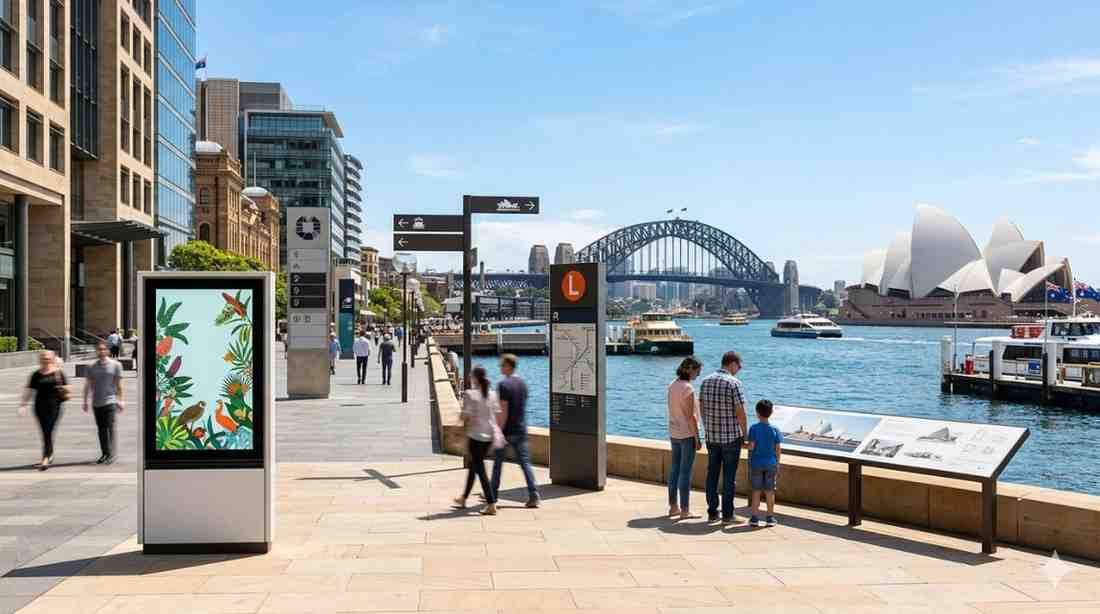
This guide covers everything a Sydney business owner, facilities manager, or marketing professional needs to know before investing in digital signage, from the types of displays that work best in different environments, to the specific Sydney considerations that affect installation, compliance, and content strategy.
Why Sydney Businesses Are Choosing Digital Signage Now
Sydney is a competitive commercial environment. Whether you're operating in the CBD, along a suburban high street in Surry Hills or Newtown, in a shopping centre in Parramatta or Chatswood, or running a hospitality venue in the inner west, the competition for customer attention is constant and intense.
Digital signage levels the playing field in ways that printed media simply cannot. Content can be changed instantly. Promotions can be timed to the hour. Multiple messages can rotate on a single screen. And the visual impact of a well-placed, well-managed digital display draws eyes in ways that static signage stopped doing years ago.
I've noticed that Sydney businesses which make the switch to digital signage almost universally describe the same experience: the change in how customers engage with their frontage or interior space is visible almost immediately, and the operational flexibility of being able to update content without reprinting anything quickly becomes something they wonder how they managed without.
According to research published by the Outdoor Media Association of Australia, digital out-of-home advertising now accounts for a growing majority of total out-of-home advertising revenue nationally, with Sydney representing one of the highest-density digital signage markets in the country. The shift is real and it is accelerating.
Types of Digital Signage Available to Sydney Businesses
Retail Digital Signage
Sydney's retail environment is diverse. From flagship stores on Pitt Street Mall to independent boutiques in Paddington and Glebe, the range of retail formats means digital signage solutions need to be equally varied.
For street-facing retail, high-brightness window displays capable of pushing through Sydney's intense summer sunlight are the priority. A window-facing screen that works beautifully on a cloudy July morning can become completely invisible on a bright January afternoon if it's not specified to the right brightness level for the window orientation and sun exposure.
Interior retail signage includes promotional display screens, digital menu boards, product showcase displays, and in-store video walls that create immersive brand environments. The goal in any retail context is content that drives purchase behaviour, reinforces the brand, and adapts to promotional cycles without manual intervention.
Hospitality Digital Signage
Sydney's hospitality sector is enormous. The city's café culture, restaurant density, and hotel market make digital signage a particularly strong investment for hospitality operators.
Digital menu boards are the most common starting point. The ability to update menu items, adjust specials, and run time-sensitive promotions without reprinting is operationally significant for any venue running a complex or frequently changing menu.
Beyond menus, Sydney hotels use digital signage for lobby displays, event listings, wayfinding across multi-level properties, and promotional content targeting guests during their stay. Restaurant groups with multiple Sydney locations use centralised content management to push consistent promotional content across every venue simultaneously.
Corporate Digital Signage
Sydney's CBD and surrounding commercial precincts, including North Sydney, Pyrmont, and Macquarie Park, are home to a concentration of corporate headquarters, professional services firms, and financial institutions that use digital signage extensively.
Corporate applications include reception and lobby displays, meeting room availability screens, employee communication displays in staff areas, and wayfinding systems across large multi-floor or multi-building campuses.
In my experience, Sydney-based professional services firms that invest in quality reception area digital displays consistently report that it elevates the first impression for visiting clients in a way that resonates well beyond the lobby. It's a small investment relative to the rental cost of prime CBD office space, but it makes that space work significantly harder.
Outdoor Digital Signage
Sydney's outdoor environment presents specific technical challenges. The combination of high summer brightness, coastal humidity in areas like Manly, Bondi, and the Northern Beaches, and the wind load requirements for elevated installations means outdoor digital signage in Sydney needs to be specified carefully.
High-brightness panels rated at a minimum of 5,000 nits for direct sun positions, IP65 or higher weatherproofing, and corrosion-resistant enclosures for coastal locations are baseline requirements for outdoor digital signage that will perform reliably through Sydney's seasonal extremes.
Outdoor applications in Sydney include shopping centre external signage, transport interchange displays, outdoor dining precinct screens, sports and recreation facility boards, and street-level retail façade displays.
Digital Signage for Healthcare and Education
Sydney's healthcare and education sectors are significant employers of digital signage technology. Hospitals including major facilities across the city use digital displays for patient wayfinding, queue management, safety communications, and public health information.
Universities and schools across greater Sydney use digital signage for campus information boards, lecture theatre displays, and interactive wayfinding. The University of Sydney, UNSW, and UTS campuses all represent the scale of digital signage deployment that larger educational institutions in the city have embraced.
Sydney-Specific Considerations for Digital Signage Installation
This is where local knowledge genuinely matters. Installing digital signage in Sydney involves navigating a set of practical, regulatory, and environmental considerations that are specific to this market.
Council and Planning Approvals
Sydney is governed by a patchwork of local government areas, each with its own development control plans and signage policies. The City of Sydney Council, Inner West Council, Northern Beaches Council, and the various other LGAs across greater Sydney each have their own requirements for illuminated signage, including digital displays.
For window-facing digital signage within a tenancy, approvals requirements are typically less onerous than for externally mounted or freestanding outdoor displays. But for any signage that projects beyond the building facade, operates above a certain brightness threshold, or is installed in a heritage conservation area, development consent or a sign application may be required.
The Digital Harbor team works with Sydney clients through the approvals process as part of every outdoor or facade-mounted installation, because the timeline for council approvals needs to be factored into the project schedule from the beginning.
Sydney's Climate and Environmental Demands
Sydney's climate is genuinely variable. Summer temperatures in western Sydney regularly exceed 40 degrees Celsius. Coastal locations from the Northern Beaches down to the Sutherland Shire face salt air exposure that accelerates corrosion in outdoor hardware. The city also experiences significant rainfall and occasional severe storms that test the weatherproofing of outdoor installations.
Specifying digital signage for a Sydney outdoor location requires honest assessment of:
- Maximum ambient temperature at the installation site, particularly for western Sydney locations
- Salt air exposure for any coastal or near-coastal installation
- Wind load requirements for elevated or freestanding installations
- Sun orientation and peak brightness requirements based on the compass direction the display faces
- Rainfall and humidity protection requirements relative to the specific microclimate of the installation location
Cutting corners on any of these specifications to reduce upfront cost is a false economy. The cost of replacing a failed outdoor display, including labour, access equipment, and hardware, consistently exceeds the cost of specifying correctly the first time.
Building Management and Landlord Requirements
A significant proportion of Sydney commercial tenancies are leased rather than owned, and most commercial leases in Sydney include provisions about what tenants can install, particularly when installations involve penetrations into walls, ceilings, or facades.
For any digital signage installation in a leased commercial space in Sydney, confirming the requirements of your lease and obtaining landlord approval where required is an essential first step, not an optional one. Building management in larger commercial buildings may also have their own requirements for electrical work, after-hours access for installation, and cable routing through common areas.
Working with a digital signage supplier who understands Sydney's commercial property landscape and has experience navigating these requirements is a genuine advantage in avoiding delays and complications.
Choosing a Digital Signage Partner in Sydney
The Sydney market has no shortage of suppliers offering digital signage products and installation services. The quality and capability of those suppliers varies considerably, and the choice you make has long-term implications for both the performance of your system and the support you receive after installation.
Here is what to look for when evaluating digital signage partners in Sydney:
- Local presence and response capability: A supplier based in or regularly operating in Sydney can respond to on-site issues far more quickly than one servicing your account remotely from interstate or overseas
- End-to-end capability: Can they supply hardware, manage installation, provide content management software, and support the system on an ongoing basis? Fragmented supply chains across multiple vendors create accountability gaps when problems arise
- Demonstrated local project experience: Ask for references from Sydney-based projects at a similar scale and in a similar environment to yours
- Knowledge of Sydney council requirements: A supplier who understands the approval landscape across Sydney's various LGAs will save you significant time and frustration on any outdoor or facade installation
- Ongoing support and service agreements: What happens after installation? Who do you call if a screen fails at 7am on a Saturday before your busiest trading day?
Digital Harbor has worked with businesses across Sydney's CBD, inner suburbs, and greater metropolitan area on digital signage installations ranging from single-screen retail deployments to multi-site corporate networks. The consistent feedback from clients is that having a locally knowledgeable partner who can be on-site quickly makes a material difference to the experience of owning and operating a digital signage system.
Content Strategy for Sydney Digital Signage
A display without a content strategy is an expensive screen. The businesses in Sydney getting the most from their digital signage investments are the ones treating content as an ongoing operational priority rather than something that gets set up at installation and forgotten.
Effective content principles for Sydney businesses:
- Localise your content: Sydney audiences respond to local references, local events, and content that feels relevant to their specific neighbourhood or context. A café in Surry Hills and a café in Parramatta serve different communities with different reference points.
- Match content to foot traffic patterns: Sydney's CBD has distinct morning commuter, lunchtime, and evening foot traffic profiles. Scheduling content to match these patterns significantly improves relevance and impact.
- Seasonal adaptation: Sydney's seasons bring genuine changes in customer behaviour, product relevance, and promotional priorities. A content schedule that refreshes with the seasons performs better than one that runs the same content year-round.
- Keep it moving: Static content on a digital screen quickly loses its advantage over printed signage. Animation, video, and regularly updated content sustain the attention benefit that makes digital signage worth the investment.
- Design for the viewing context: Street-facing content in busy Sydney locations needs to communicate in two to three seconds. In-store or corporate content can carry more detail. Designing for the specific viewing context of each screen location is essential.
Installation Timeline: What to Expect for a Sydney Project
Understanding the realistic timeline for a digital signage project in Sydney helps with planning and avoids frustration when regulatory or logistical factors add time to the schedule.
Week one to two: Site assessment, hardware specification, content management platform selection, and initial brief development.
Week two to four: Hardware procurement and any required council or landlord approval applications. Approval timelines vary significantly by council area and application type.
Week four to six: Installation scheduling, electrical and network infrastructure preparation, and hardware delivery.
Week six to eight: Physical installation, system configuration, content management platform setup, and staff training on the CMS.
Ongoing: Content management, scheduled maintenance, and system monitoring.
For straightforward single-screen indoor installations without approval requirements, the timeline compresses significantly. For complex outdoor or multi-screen deployments in regulated environments, building additional time into the schedule for approvals is strongly recommended.
Digital signage is one of the most versatile and commercially effective communication investments available to Sydney businesses right now. The technology is mature, the supply chain is established, and the range of available solutions covers every business size, every industry, and every environment the Sydney market presents.
Getting it right means choosing the correct specification for your environment, planning the installation properly, navigating Sydney's specific regulatory landscape with the right support, and committing to a content strategy that keeps the screens working as hard as the rest of your business. That combination is what separates digital signage that delivers genuine commercial return from a screen that simply occupies wall space.