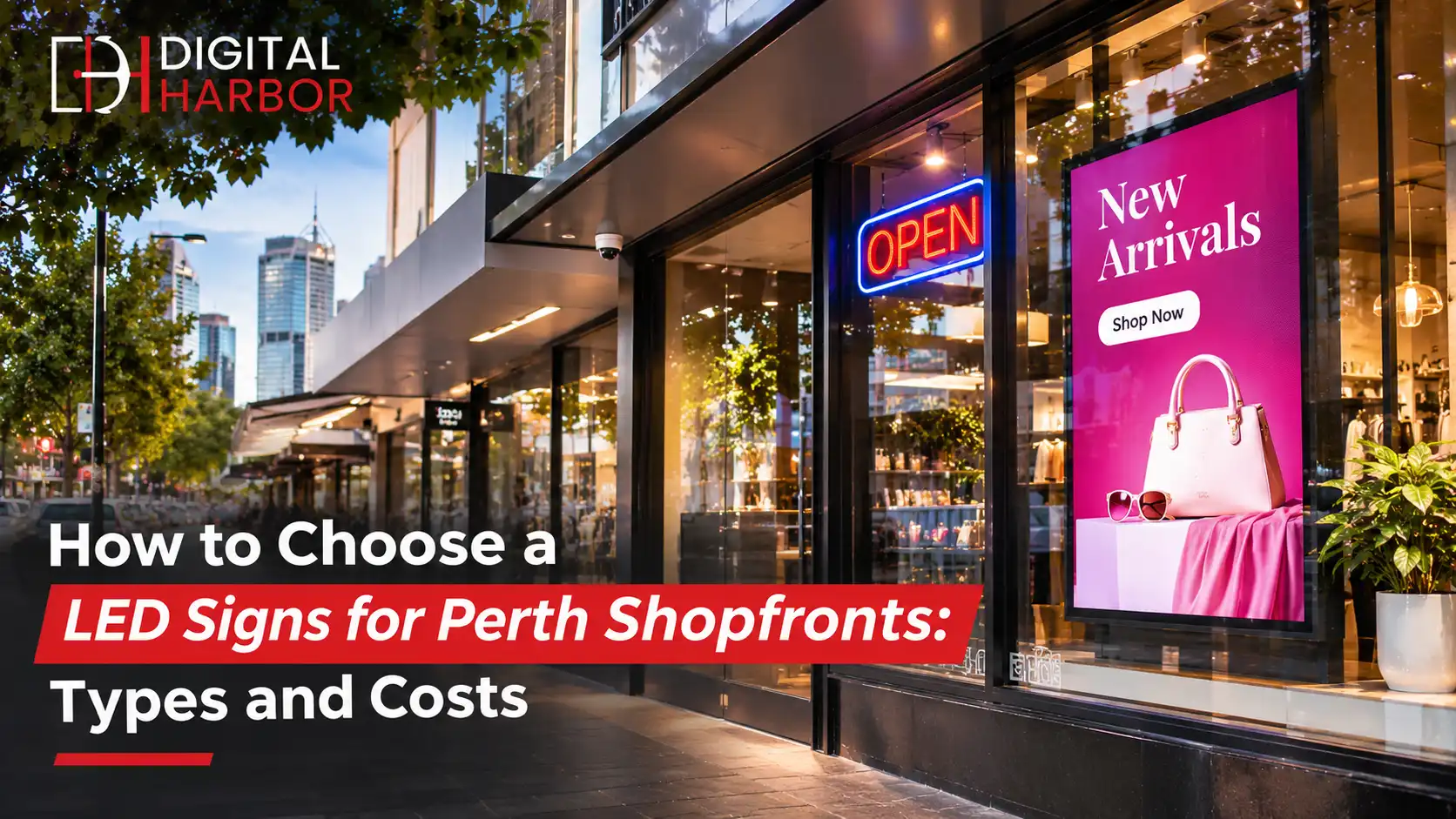
LED shop signs range from a simple open sign to a full-colour window screen. This Digital Harbor guide explains the types, what drives cost, brightness for Perth sun, approvals and how to choose a sign that suits your shopfront.
A shop sign in Perth does two jobs at once. In the morning it has to be seen over glare, and after dark it has to stand out from every other lit window on the strip. LED signs handle both well, which is why they have replaced many neon and lightbox signs along Perth shopping streets. They are also available in more forms than most owners expect, from a small open sign to a full-colour screen.
This guide explains LED signs for Perth shopfronts: the main types, what drives the cost, how to handle Perth sun and heat, what approvals to check and how to choose a sign that fits your frontage. If you want to see the range first, visit our electronic signs in Perth page.
What Counts as an LED Shop Sign?
An LED sign uses light-emitting diodes to show text, shapes or images. The category is broad, so it helps to separate it into groups by what the sign can show and where it is fitted.
- Simple LED signs: fixed shapes such as open signs, arrows and outlines, often with a few colours or flashing modes.
- Scrolling text signs: single-line or multi-line signs that show moving words, prices or messages.
- Full-colour LED screens: displays that show photos, video and animated offers, controlled by software.
- LED strip and channel lettering: lit letters and outlines that carry your shop name at night.
The right choice depends on how often your message changes, how far away people see it and how much you want to spend.
Types of LED Shop Signs in More Detail
LED open signs
The most familiar type. An LED open sign hangs in the window and tells people you are trading. It is low cost, easy to fit and needs almost no maintenance. It does one job well, but it cannot show offers or change with the day.
Scrolling and programmable text signs
These signs show lines of text that you update with a controller. They suit takeaways, convenience stores and service shops that want to show prices, opening hours or a short promotion. Text is easy to read from a distance, but there is little room for imagery.
Full-colour window screens
A high-brightness LED or LCD screen behind the glass turns the window into a moving poster. You can show photos, video, offers and your brand, and you can schedule different content by time of day. Our window display range covers options made for street-facing frontages.
Fixed outdoor LED panels
For signs mounted outside the building, on a wall, an awning or a pole, you need weatherproof panels with higher brightness. Our outdoor LED screens are sealed and made for Australian weather.
Standard-size and custom LED panels
Wide, narrow strips suit signs above doors and across awnings. Standard sizes, such as our 1920 x 640 LED display, are practical for these frontages, and a custom LED display can be built to fit a specific opening.
What Affects the Cost of an LED Shop Sign?
Prices range widely, from a small open sign at the low end to a large, outdoor, full-colour display at the high end. Because the spread is so large, it helps to know what drives the figure.
- Size: larger signs need more LED modules, more structure and more power.
- Colour and resolution: single-colour signs cost less than full-colour screens, and finer pixel pitch costs more.
- Brightness and weather rating: outdoor and window-facing signs need much more brightness and protection.
- Controller and software: programmable signs need a controller, and some systems charge licence fees.
- Installation: mounting, power, cabling and any structural work add labour.
- Approvals and extras: council paperwork, engineering sign-off and access equipment can add cost.
Always ask for an itemised quote. Our guide to digital signage pricing in Australia shows how to compare quotes and what each line normally covers.
Handling Perth Sun, Heat and Dust
Local conditions affect which sign suits your shopfront. Strong sun can wash out a dim sign in a window, long hot summers stress electronics and dust affects fan-cooled units. Coastal suburbs add salt, which attacks metal fixings.
- Choose a sign with enough brightness for daylight, and with automatic brightness control for night.
- Check the operating temperature range and cooling method, especially for signs in sealed window boxes.
- For outdoor signs, look for a sealed rating such as IP65, and corrosion-resistant fixings near the coast.
- Leave airflow around the sign and keep vents clean.
Choosing a Sign for Your Type of Shop
- Cafes and takeaways: a window screen for specials, plus an open sign for trading hours. Pair it with a digital menu display inside.
- Fashion and gift shops: a full-colour window screen that shows new arrivals and sales.
- Service businesses such as salons and clinics: a simple LED sign for hours and bookings, and a screen inside for services.
- Car yards and showrooms: an outdoor LED display for offers that drivers can read from the road.
Approvals and Rules in Western Australia
Indoor signs rarely need approval. Signs that face the street, are illuminated or show moving content often do. In Western Australia, local governments set rules on sign size, illumination, moving images and placement, and Main Roads WA may apply extra conditions near main roads. Shopping centre owners and landlords can add their own restrictions on shopfront changes.
Check these before you buy, because a sign that cannot be switched on is an expensive ornament. Electrical work must be done by a licensed electrician.
Content Tips for Shopfront Signs
- Keep the message short. Passers-by look for a few seconds.
- Use large text and strong contrast.
- Avoid fast flashing, which can annoy neighbours and may be restricted.
- Change your offer often so regulars notice.
- Add a clear next step, such as opening hours or a short web address.
Installation and Maintenance
Window signs can be hung from chains or fixed to the frame. Wall and awning signs need brackets suited to the building. Plan power early, so cables are hidden and safe, and leave access for servicing. Clean the sign and check the content every few weeks, and ask the supplier how faults are handled. For LED, ask where spare modules are held, because a part that has to be imported can leave a dark patch for weeks.
LED or LCD for a Window Sign?
Many shop owners compare an LED sign with a high-brightness LCD screen for the window. LCD gives a sharp picture at close range and often costs less for a small screen, but it shows a visible edge and may not be bright enough for a sunny frontage. LED can be much brighter, has no bezel and can be built to fit unusual openings, but it costs more per square metre as the pixel pitch gets finer. If your window gets direct afternoon sun, or you want a wide strip above the door, LED is usually the safer choice. If your window is shaded and the screen is small, a high-brightness LCD may be enough.
Running Costs and Energy Use
An LED sign draws power in proportion to its size and brightness, and a sign running from early morning to late evening adds up over a year. A few habits keep the bill under control without hurting visibility.
- Use brightness control, so the sign dims automatically after dark.
- Schedule the sign to switch off after closing time and on before opening.
- Choose a sign sized to the viewing distance, not the biggest one that fits.
- Ask the supplier for a power estimate in the quote, so you can budget for the year.
A Sample Plan for a Small Perth Shop
A simple plan helps you decide where to start. Take a boutique on a busy shopping strip with a west-facing window. A sensible first step is a high-brightness window screen that shows new arrivals and the current sale, with brightness control so it does not glare at night, and an LED open sign that shows trading hours after dark. Both can be fitted in a day once the equipment arrives. Run them for a month, note which messages draw people in and then decide whether to add an outdoor sign above the door or a second screen inside.
A cafe on the same strip might skip the boutique screen and use the budget for a digital menu board over the counter plus a window screen for the day's special. The point is to match the sign to the job, not to buy the largest display available.
Questions to Ask Before You Order
- What brightness does this sign deliver, and is it suitable for my window or frontage?
- Is it rated for Perth summers, and how is it cooled?
- What is included in the quote, and are there monthly software fees?
- Who installs it, and are they licensed for the electrical work?
- What does the warranty cover, and how fast can you replace a module?
Common Mistakes to Avoid
- Buying a dim indoor sign for a west-facing window.
- Choosing the sign before checking council and landlord rules.
- Leaving the sign at full brightness all night.
- Using too much text on a sign that people read from across the street.
- Skipping a warranty check and support plan.
A Simple Process
- Decide what the sign has to do: show hours, promote offers or build your brand.
- Choose the sign type that fits the message and budget.
- Check sun direction, viewing distance and approvals.
- Ask for an itemised quote with warranty and support listed.
- Plan your first month of content before installation.
How Digital Harbor Can Help
Digital Harbor supplies, installs and supports LED signs and displays for businesses across Australia, including Perth. We look at your frontage, recommend the right sign for your space and give you an itemised quote.
See our recent work or contact us for a free consultation.