There is a common misconception that digital signage is a big-budget tool reserved for national retail chains, shopping centre operators, and corporate headquarters. Walk past enough independent cafes, boutique retailers, and local service businesses in any Australian suburb, and you start to see how wrong that assumption is.
Small Business. Big Screen Energy.
There is a common misconception that digital signage is a big-budget tool reserved for national retail chains, shopping centre operators, and corporate headquarters. Walk past enough independent cafes, boutique retailers, and local service businesses in any Australian suburb, and you start to see how wrong that assumption is.
Small businesses that have made the move to digital signage are not just looking more professional. They are attracting more walk-ins, selling more at the counter, spending less on print, and competing on a visual level that was simply not possible five years ago.
The technology has caught up with the budget reality of small business. Hardware costs have dropped significantly. Software platforms have become genuinely easy to use. And the commercial case, more foot traffic, higher average spend, lower ongoing costs, has never been clearer.
This guide is written specifically for Australian small business owners who want to understand which digital signage solutions actually make sense for their size, their space, and their goals.
Why Small Businesses Cannot Afford to Ignore Digital Signage Anymore
The competitive landscape for small business in Australia has shifted. Your online presence matters, but so does your physical one. When a potential customer walks past your shopfront, you have roughly three seconds to give them a reason to stop.
A static A-frame or a printed window poster is not built for that job. A bright, motion-based digital window display is.
Beyond the street-level impact, digital signage solves a problem every small business owner knows intimately: the cost and friction of keeping promotional materials current. Printing new posters every time a price changes, a promotion ends, or a new product launches adds up fast in both dollars and hours. A digital signage setup eliminates that cycle entirely.
Consider what Australian small businesses are actually dealing with:
- Rising costs of print production and installation
- Difficulty competing visually with larger, better-resourced competitors
- Staff time wasted on manual signage updates
- Missed upsell opportunities at the point of sale
- Promotions that cannot respond quickly to competitor activity or market changes
Digital signage addresses every single one of those pain points. And for small businesses specifically, the return on investment tends to arrive faster than most owners expect.
The Right Fit: Matching Solutions to Small Business Types
Not every small business needs the same setup. The most effective approach is matching the solution to the specific environment, customer journey, and commercial goal. Here is how that plays out across the most common small business categories in Australia.
Cafes and Independent Restaurants
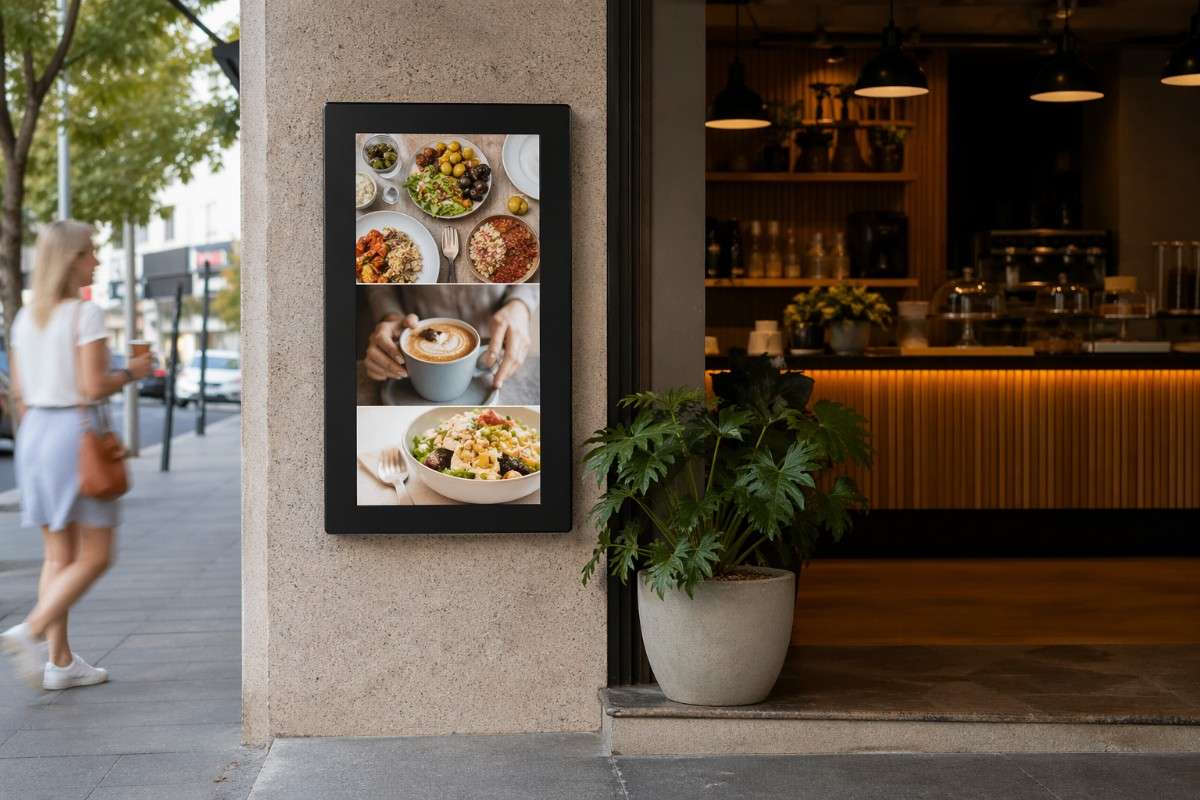
The digital menu display is one of the highest-impact investments a food and beverage business can make. For cafes and restaurants operating with slim margins and frequent menu changes, the ability to update pricing, add seasonal specials, and remove sold-out items in real time is not just convenient. It is genuinely profitable.
What works well for this category:
- Wall-mounted digital menu boards behind the counter replacing printed menus
- Counter-facing screens promoting daily specials and upsell items like desserts or premium add-ons
- Window-facing displays showing the menu or atmosphere content to attract passing foot traffic
- Queue area screens running loyalty program prompts and return-visit incentives
A single digital menu display setup for a small cafe typically pays back its cost within six to twelve months through reduced print expenses and increased upsell conversion alone.
Boutique Retail and Fashion
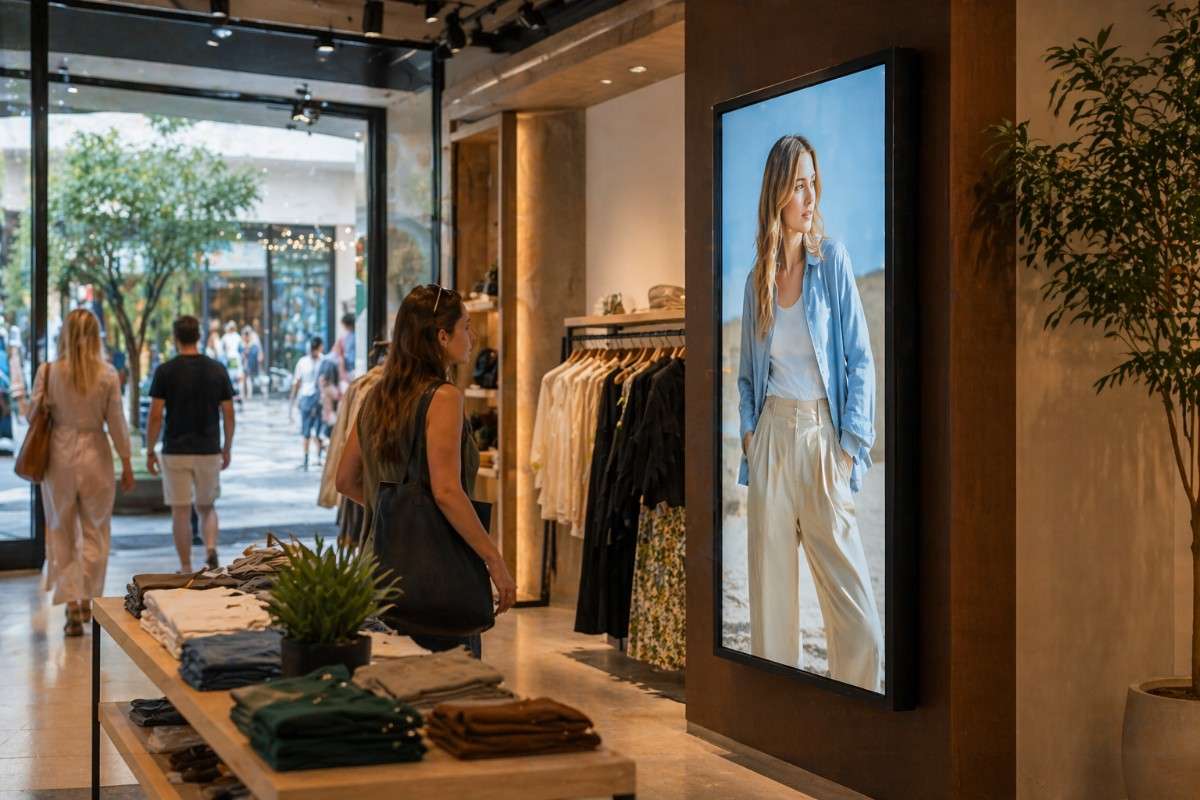
For independent retailers, the window is everything. A boutique that runs high-brightness commercial display screens in its window can showcase new arrivals, current promotions, and brand story content in a way that stands out dramatically from neighbouring stores still relying on printed posters.
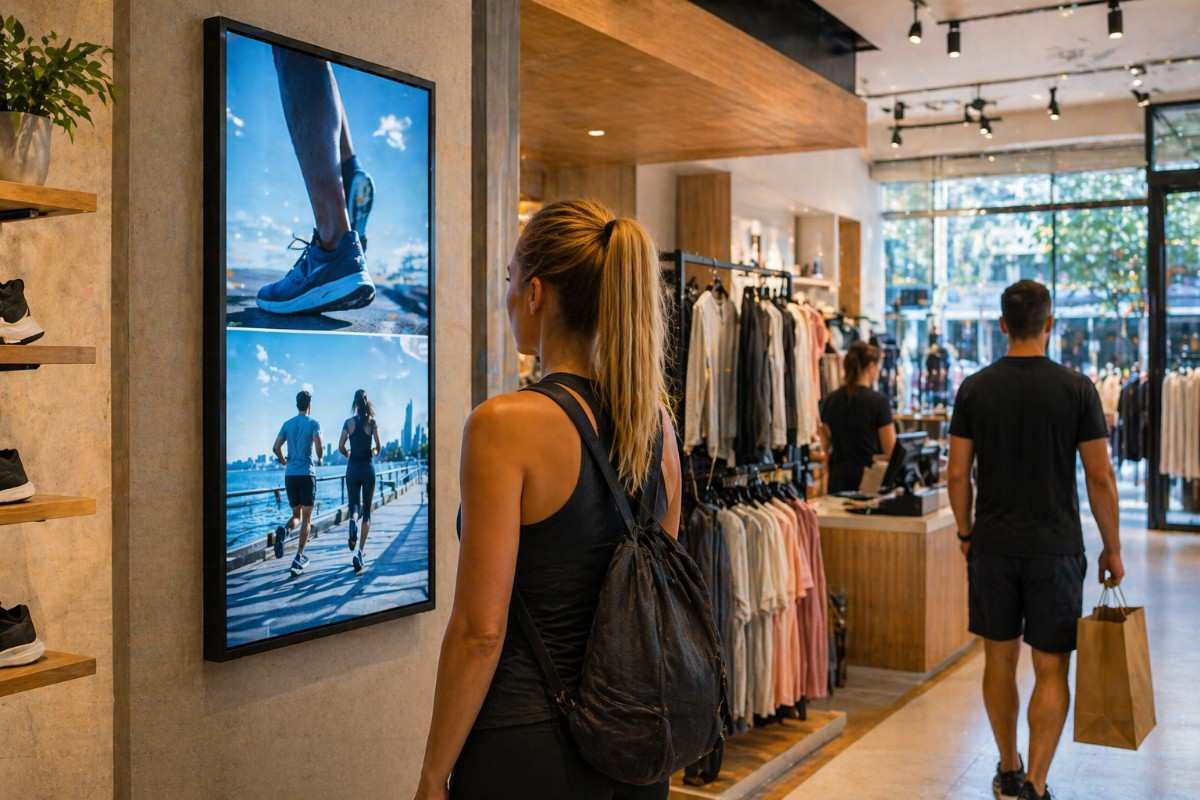
Inside the store, digital signage supports:
- New season campaign content at the entry zone
- Product storytelling screens near feature displays
- Lookbook-style video content that increases dwell time
- Loyalty and referral program prompts near the register
The visual lift that digital signage delivers for a boutique retailer also directly influences perceived brand quality. Customers associate dynamic, polished in-store displays with premium products, which supports pricing integrity and reduces the pressure to compete on discounting alone.
Hair, Beauty, and Wellness
Salons, barbershops, skin clinics, and wellness studios all share a common trait: customers spend time waiting. That dwell time is a content opportunity that most businesses in this category are not using.
Screens in waiting areas can run:
- Service menus and pricing displays
- Before-and-after treatment showcases
- Product education content that supports retail sales
- Booking and referral incentive prompts
- Ambient lifestyle content that enhances the in-space experience
For beauty and wellness businesses, digital signage also plays a key role in supporting retail product sales. A screen near the retail shelf running a short demonstration video of a product will consistently outsell the same product displayed without supporting content.
Trade, Professional Services, and Healthcare
Waiting rooms in medical practices, dental clinics, accounting offices, and trade showrooms all benefit from digital signage, though the goals here lean more toward education and experience than direct product promotion.
Screens in these environments work well for:
- Service and treatment information that reduces staff explanation time
- Health awareness content in clinical settings
- Portfolio and project showcase content in trade showrooms
- Appointment reminder and booking prompt displays
- Corporate messaging and values content in professional service offices
For healthcare providers in particular, well-placed commercial display screens reduce perceived wait times, lower patient anxiety, and create opportunities to introduce additional services that patients might not otherwise be aware of.
Gyms and Fitness Studios
The fitness category has embraced digital signage enthusiastically, and for good reason. Members respond strongly to visual content in training environments. Screens can run class schedules, trainer introductions, member spotlights, challenge leaderboards, and motivational content simultaneously.
For small independent gyms and studios competing against franchise chains with larger marketing budgets, digital signage is one of the most effective ways to create an experience that rivals or exceeds what the bigger players offer.
The Four Solutions Every Small Business Should Know
Digital Window Display
This is the entry point for most small businesses and often the highest-returning investment. A high-brightness screen mounted in or facing a street-facing window converts passive foot traffic into active walk-ins.
Key specifications to look for:
- Brightness of at least 2500 nits for window-facing positions in sunny conditions
- Commercial-grade panel rated for extended operating hours
- Remote content management via cloud-based platform
- Portrait and landscape orientation compatibility
Digital Harbor's window display solutions are engineered specifically for Australian light conditions, with brightness levels that maintain full visibility even in direct afternoon sun.
Digital Menu Display
Designed for food and beverage businesses but increasingly adopted by service businesses displaying service lists and pricing. The combination of visual appeal, real-time updateability, and the ability to schedule different content for breakfast, lunch, and dinner service makes this one of the most versatile small business digital signage solutions available.
What to prioritise:
- Simple content management interface your team can use without technical support
- Template-based design tools so you are not reliant on a designer for every update
- Scheduling functionality for automatic content changes by time of day or day of week
- Integration capability with POS systems for automatic price updates
Indoor Commercial Display Screens
For in-store promotional content, product information, and queue area upselling, a standard commercial display screen mounted at eye level or slightly above delivers reliable results. These differ from consumer televisions in critical ways: they are rated for continuous operation, have brighter panels, include commercial-grade warranties, and offer input options suited to signage applications.
A common small business configuration pairs one screen near the entry zone with another near the register or service counter, creating a simple but effective two-point content journey that covers both the inspiration and conversion phases of the customer visit.
Portable Outdoor Display
For businesses that participate in markets, events, or outdoor trade, or who want flexible signage capability that can be repositioned as their needs change, a portable outdoor digital display offers a practical and increasingly popular option.
These units are weatherproof, self-contained, and can be repositioned without installation work. For small businesses that are not yet ready to commit to fixed installation, a portable unit offers a low-friction entry point into digital signage with genuine commercial capability.
What Small Businesses Get Wrong When Buying Digital Signage
The hardware decision is only part of the picture. Small business owners who focus exclusively on screen size and price, without thinking about content strategy and management, consistently underperform those who treat digital signage as an ongoing communications tool rather than a one-time purchase.
The most common mistakes:
- Buying consumer-grade televisions instead of commercial display screens: Consumer panels are not built for continuous operation. They will fail faster, look worse in bright conditions, and carry warranties that do not cover commercial use.
- No content plan at purchase: A screen with no content strategy quickly becomes a screen showing a screensaver. Before you buy, know what you are going to show, how often you will update it, and who is responsible for managing it.
- Underestimating brightness requirements: This is especially critical for window-facing positions. A screen that looks great in a dim showroom can be completely invisible in a sunlit window during peak trading hours.
- Choosing a platform you cannot manage yourself: If updating your screen content requires calling a third party every time, you will stop updating it. Prioritise platforms with simple, self-service interfaces designed for non-technical users.
- Installing screens without a placement strategy: Position screens where your customers naturally look during key moments in their visit, not simply where it is easiest to run a cable.
Total Cost of Ownership: What Small Businesses Actually Pay
One of the most important reframes for small business owners evaluating digital signage is shifting from upfront cost to total cost of ownership over a three-year period.
When you factor in:
- Eliminated print production costs across three years
- Staff hours saved on manual signage updates
- Incremental revenue from upsell and foot traffic capture
- The cost of not having digital signage while competitors do
The investment case becomes considerably clearer. Most small business installations in the cafe, retail, and wellness categories recover their full investment within twelve to twenty-four months, with ongoing savings and revenue contribution continuing beyond that point.
For businesses in high-footfall locations with active promotional calendars, that payback window can be as short as six months.
How to Choose the Right Digital Signage Partner in Australia
The quality of your digital signage outcome depends significantly on the partner you choose. A screen is a commodity. The strategy, installation, content management platform, and ongoing support behind it are what drive results.
When evaluating providers, prioritise those who:
- Offer end-to-end service from consultation through to installation and support
- Have demonstrable experience with businesses in your specific category
- Provide hardware specifications matched to your environment, not generic recommendations
- Include a content management platform that your team can operate independently
- Offer transparent warranty and support terms with clear escalation paths
Digital Harbor works exclusively with Australian businesses and brings category-specific experience across hospitality, retail, wellness, healthcare, and trade environments. Every installation begins with a consultation focused on your business goals and physical space, not on pushing a particular product configuration.
The Competitive Reality for Australian Small Business in 2026
Your competitors are not standing still. Across Australian high streets, shopping strips, and suburban retail precincts, more small businesses are making the move to digital signage every month. The visual gap between businesses that have made the transition and those that have not is becoming increasingly obvious to the customers walking past both.
The question for most small business owners is no longer whether digital signage delivers results. The evidence on that is clear. The question is how to implement it in a way that is right-sized for your business, manageable with your existing resources, and positioned to grow as your needs evolve.
Start With a Conversation, Not a Purchase Order
The best digital signage decisions come from understanding the space, the customer journey, and the commercial goals before selecting any hardware. That is why Digital Harbor offers obligation-free consultations for small businesses across Australia.
Bring your floor plan, your current signage challenges, and your growth targets. Leave with a clear, practical recommendation for what will actually work in your specific situation.
Talk to a Digital Harbor expert today. No obligation, no pressure, just a straight answer about what digital signage can do for your business.